Most traders fail at prognosticating reversals. Traders lose money at turning points. The reason is that their confirmations arrive too late. By the time a reversal is obvious, the move is already well underway, entries are sloppy, and stops are too far from price to make the risk-reward worthwhile.
ICT trading methods address this problem head-on with a structured sequence of reversal signals. Rather than relying heavily on single indicator to declare a trend shift, there are three concepts in ICT reversal trading patterns framework: The IFVG/BPR, the CISD, and the MSS.
Together, they form a hierarchy of reversal evidence.

Table of Contents
Why ICT Reversal Trading Patterns Work?
Traditional reversal signals like divergence, overbought and oversold readings, or candlesticks patterns have a fundamental weakness. These traditional signals are reactive in nature. They respond to what price has already done, not to the underlying mechanics driving that move.
The ICT reversal framework is grounded SMC trading methodology presented by Michael J. Huddleston. The idea in SMC is that institutional order flow leaves traceable evidence in price action.
When a trend is genuinely weakening, that weakening shows up first in how price interacts with existing imbalances and recent swing highs and swing lows. Reading these signals in order to gives you a front-row view of institutional repositioning before the wider market has caught on.
These patterns also be used for lower timeframe confirmation for trade entry when price reached a higher timeframe PD array.
Pattern 1: ICT IFVG and BPR
In a healthy trend, market moves with strong candles. Displacement candles create FVGs that act as magnets. Price repeatedly returns to these imbalance zones, fill them and continues in the trend’s direction. When that relationship breaks down, the gap inverts and becomes what is known as an Inversion Fair Value Gap (IFVG).
An IFVG is the market’s earliest admission that something has changed. Algorithmic price delivery that previously defended that zone has been broken. It is weak initial signal, meaning it should not be traded in isolation. However, it is considered as a first crack in the structural integrity.
The signal becomes considerably more powerful when the price action that breaks through an existing FVG simultaneously creates a new FVG pointing in the opposite direction.
The overlapping structure is what ICT defines as balanced price range (BPR). The BPR communicates two things at once: the old trend is weakening, and a new counter-directional institutional commitment has just appeared.
Pattern 2: ICT CISD
Change in state of delivery focuses on price rhythm. CISD is the recognition that the first line of defense against the major trend has been broken. Breaking a structurally significant level with displacement candlesticks is alarming situation for reversal traders.
Bullish price delivery is a series of consecutive bullish candles each closing higher than the last. The reference point for that delivery sequence is the closing price of final bearish candle before the bullish run began. That level represents the launch point of the buying sequence.
When the price falls back below that launch point and closes beneath it, the bullish delivery has been interrupted. That is a bearish CISD. The inverse applies to a bearish run.
It is ranked as the second level of reversal confirmation in the ICT sequence, CISD occupies a particularly useful position. It arrives earlier than a full market structure shift, which means entries taken on CISD signals tend to catch more of the move.
The tradeoff is that not every CISD leads to a sustained reversal. There are some temporary corrections within a larger trend.
This is why context matters. A bearish CISD occurring at a higher timeframe resistance zone, inside a PD array, during a London or New York Kill zone carries substantially more weight than one forming in the middle of a range during low-volume hours.
After the delivery state changes, price typically retrace. Rather than chasing the initial move, the disciplined approach is to wait for that retracement to reach a breaker block, IFVG, FVG or BPR that formed during the CISD sequence. However, the best method is to wait for the final confirmation MSS.
Pattern 3: ICT MSS
The ICT market structure shift is the most definitive of the three reversal patterns. While the IFVG hints at weakness and the CISD reflect a change in momentum, the MSS declares a structural break.
In MSS, price must violate a swing high or swing low with strong candlesticks.
In a bullish trend, the sequence of higher swing highs and higher swing lows maintains the structure. The moment price breaks below the most recent higher swing low with conviction, the bullish structure is compromised. That is a bearish MSS.
The inverse applies to a bearish trend.
After the MSS confirmation, the trade setup involves patience rather than impulse. The immediate post-MSS price action will be often sharp and difficult to enter cleanly. The better approach is to let the price retrace to a structural zone and enter on the retest.
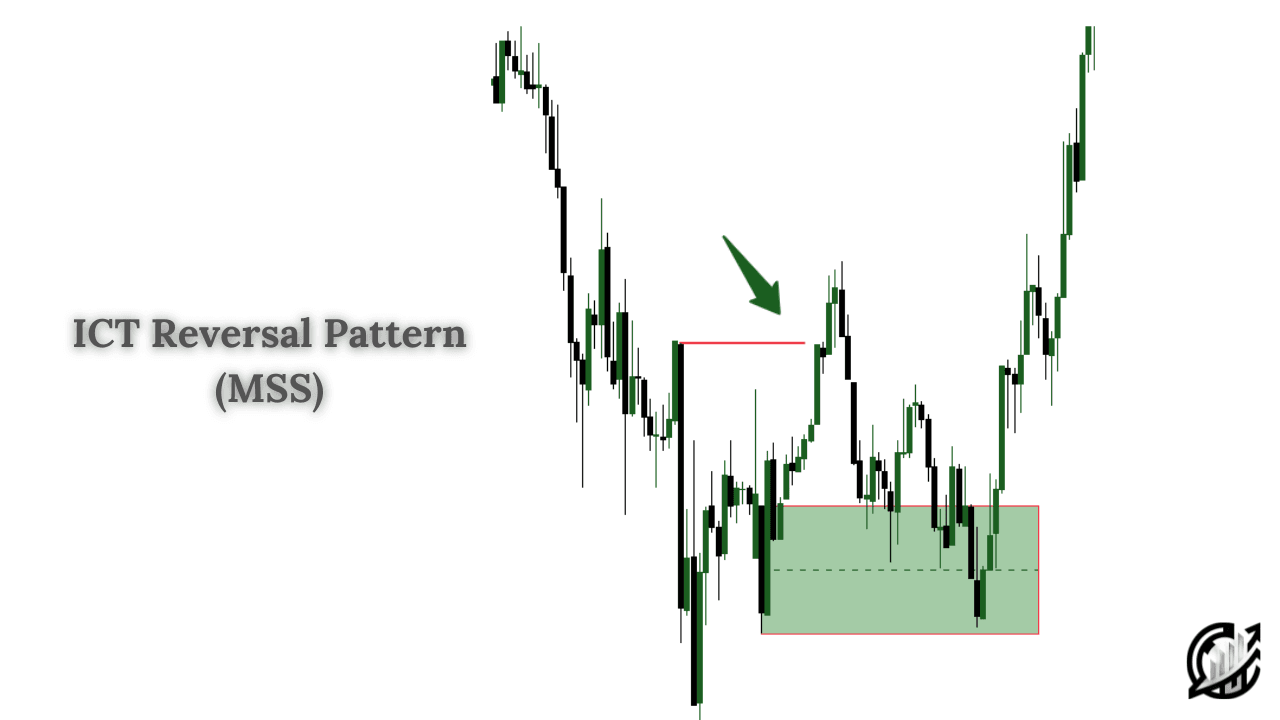
The structural zone can be breaker block, IFVG, FVG or BPR that formed during the structure-shifting move. Stop-loss placement sits just beyond the retracement zone. The initial profit target is typically the nearest draw on liquidity.
Final Thoughts
These three ICT reversal patterns offer a simple and a structured framework for identifying trend changes before the majority of market participants have recognized them.
Whether you’re approaching a higher-timeframe PD array looking for entry confirmation, or spotting the early signs of a trend change on a clean chart, these patterns give you a vocabulary for reading what institutional price action is communicating. This article is for educational purposes only and does not constitute financial advice. All trading involves risk. Always apply appropriate risk management in live market conditions.

I’m Abdullah Shah, a content writer with three years of experience in crafting engaging and informative content. My background in market analysis complements my work, allowing me to create content that resonates with audiences. I’m also a seasoned practitioner in the forex and crypto markets, with a strong foundation and deep interest in finance. My passion for the financial world drives me to produce content that is both insightful and valuable for those interested in understanding market trends and financial strategies.