Downtrends rarely end in a single moment. Before the final low, there’s usually a warning shot — a day or a cluster of days when the decline suddenly meets resistance from buyers. Volume rises, the falling price hesitates, and for a moment it looks as though the bottom might be in.
Richard Wyckoff’s method calls this first hesitation Preliminary Support (PS). It’s the opening event of Phase A in an accumulation range, and it’s one of the most misunderstood. Many traders buy it, thinking the bottom has arrived, only to watch price fall further into a selling climax.
This guide explains what PS is, how to tell it apart from an ordinary bounce, and why it so often fails before the real low.

What Is Preliminary Support?
StockCharts’ Wyckoff tutorial defines PS as the point “where substantial buying begins to provide pronounced support after a prolonged down-move.”
In simple terms: after a long decline, larger buyers start stepping in for the first time. Their buying is big enough to slow the fall — but not yet big enough to stop it.
The below are the features of preliminary support in Wyckoff trading methodology:
- It appears after an extended and often deep downtrend.
- Volume rises noticeably compared with recent bars.
- Spread widens as buyers and sellers clash.
- From price action view, the decline pauses or produces long lower wicks.
- The outcome can be a temporary stall, followed by further selling.
Think of PS as the first tap on the brakes of a speeding car. The car slows, but it hasn’t stopped.
Where PS Sits in the Accumulation Story?
Wyckoff events are interesting in his trading methodology. Preliminary support is the first sign of meaningful buying. After the appearance of preliminary support, downtrend gets slow. Price often takes a little rest.
Selling climax (SC) is a sign of panic selling being absorbed. After the appearance of selling climax, price often sets the floor for range-bound price action before taking its next move. On the other hand, role of automatic rally is to set the range ceiling. Secondary test is the retest of the SC area on lighter volume.
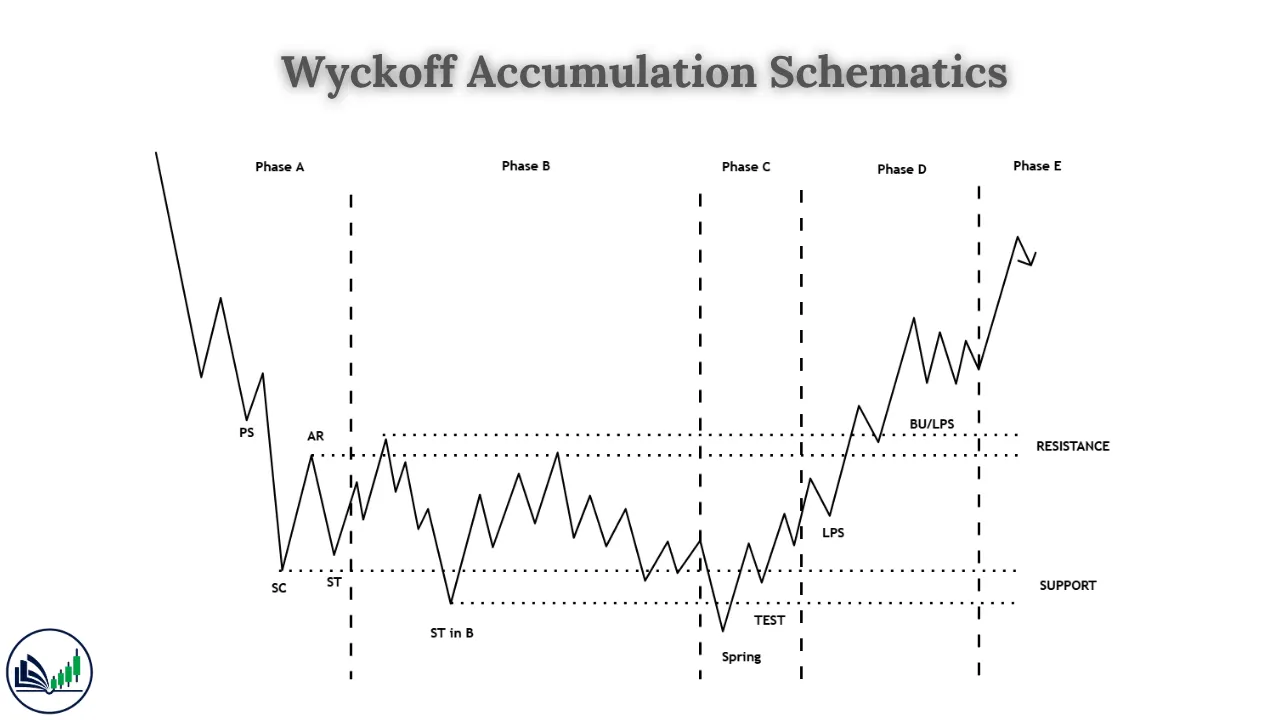
Preliminary support comes before the climax. It announces that the downtrend is mature and that larger buyers have started paying attention — but it doesn’t end the decline.
Why Volume Rises at PS?
During a long decline, volume often expands as fear spreads. At PS, part of that volume is new buying: institutions or value-oriented buyers deciding prices have fallen enough to begin a position.
To answer this logically, we need to answer Who is selling at PS, and who is buying at PS. In preliminary support, selling happens from the side of nervous holders, stop-loss orders, and margin calls. On the other hand, buyers can be patient traders, short sellers taking some profit, and funds starting small positions.
The extra buying shows up as rising volume with a slowing decline — effort that no longer produces the same downward result.
PS vs a Normal Bounce: How to Tell the Difference
Downtrends are full of bounces. Most mean nothing. Here’s how PS differs:
| Feature | Normal Bounce | Preliminary Support |
|---|---|---|
| Trend maturity | Can occur anywhere in a decline | Appears after a prolonged, often steep decline |
| Volume | Often light or average | Noticeably higher than recent bars |
| Price behaviour before it | Steady decline | Decline often accelerating — fear building |
| Bar character | Ordinary up-bar | Wide bars, long lower wicks, or closes well off the lows |
| Effort vs result | Small effort, small rebound | Large effort, decline clearly slows |
| What follows | Trend resumes quickly | A pause, then usually a final flush (SC) |
Three Quick Tests
- Is this decline old and extended? PS needs a long down-move first.
- Did volume jump while the decline slowed? That’s buying meeting selling.
- Did bars close off their lows? That shows buyers absorbing supply.
If you answer “yes” to all three, you may be looking at PS. If volume is light and the bounce simply drifts, it’s more likely an ordinary relief rally — sometimes called a “dead cat bounce.”
Why PS Often Fails Before the Real Low
This is the most important lesson about preliminary support: it rarely marks the final bottom.
1. Early Buyers Aren’t Strong Enough Yet
PS buying is real, but it’s the first wave. Supply still outweighs it. Once the bounce fades, sellers regain control.
2. Fear Hasn’t Peaked
Capitulation — the moment when the last frightened holders give up — usually comes after PS. That’s the selling climax, and it often drives price below the PS low.
3. Professionals Want Lower Prices
Large buyers who started at PS often welcome another drop. A final flush lets them buy more cheaply from panicked sellers.
4. Bounce Buyers Become Future Sellers
Traders who buy the PS bounce, hoping it’s the bottom, often sell when price turns down again. Their selling adds fuel to the climax.
| Stage | What Happens |
|---|---|
| PS | Buying slows the decline; a bounce appears |
| Bounce fades | Sellers return; hope turns to disappointment |
| Climax | Panic selling hits — usually below the PS low |
| Absorption | Strong hands buy the panic; the real floor forms |
What PS Tells You (Even When It Fails)
PS isn’t useless just because it isn’t the bottom. It’s an early warning that:
- The downtrend is mature
- Larger buyers have started to engage
- A selling climax may not be far away
- A trading range may soon form
For existing short sellers, PS is a signal to tighten stops or take partial profits. For would-be buyers, it’s a signal to start watching closely — not necessarily to buy.
How Traders Use Preliminary Support
| Trader Type | How They Use PS |
|---|---|
| Short sellers | Reduce exposure; the easy part of the decline may be over |
| Patient buyers | Begin monitoring for the selling climax and secondary test |
| Aggressive buyers | Small, speculative positions with tight stops — accepting a high failure rate |
| Wyckoff analysts | Mark PS as the first label of a possible accumulation range |
Most Wyckoff practitioners prefer to wait for later events — the SC, AR, ST, and especially Phase C and D signals — before committing serious capital.
PS in Distribution: The Mirror Image
PS has a twin at market tops: Preliminary Supply (PSY). After a long rally, large holders begin selling for the first time, volume rises and the advance slows — but the final top (the buying climax) usually comes later.
| Accumulation | Distribution |
|---|---|
| Preliminary Support (PS) | Preliminary Supply (PSY) |
| Buying slows a decline | Selling slows an advance |
| Often fails before the Selling Climax | Often precedes the Buying Climax |
Connecting PS to VSA
If you follow Volume Spread Analysis, PS often appears as the first signs of absorption or early stopping volume — high-volume down-bars that close off their lows. The difference is context: in Wyckoff, PS is specifically the first such action in a mature decline, and it’s expected to be followed by a more dramatic climax.
Common Mistakes
- Treating PS as the bottom. It usually isn’t.
- Labelling every bounce as PS. Without a long decline and rising volume, it’s just a bounce.
- Buying big at PS. Position size should be small, if you buy at all.
- Ignoring the follow-up. Watch for the SC, AR and ST that typically come next.
- Expecting PS in every range. Some declines end without a clear PS.
Conclusion
Preliminary Support is the first crack in a downtrend’s armour. Rising volume and a slowing decline show that larger buyers have started to engage — but the market usually needs one more wave of fear before a real floor forms.
Recognise PS for what it is: an early warning, not a buy signal. Mark it on your chart, tighten any shorts, and watch for the selling climax, automatic rally and secondary test that typically follow. Patience at PS often leads to far better opportunities later in the range.

I’m Abdullah Shah, a content writer with three years of experience in crafting engaging and informative content. My background in market analysis complements my work, allowing me to create content that resonates with audiences. I’m also a seasoned practitioner in the forex and crypto markets, with a strong foundation and deep interest in finance. My passion for the financial world drives me to produce content that is both insightful and valuable for those interested in understanding market trends and financial strategies.