For beginner SMC and ICT traders, understanding market structure seems bit confusing. The reason is that some concepts are opposite of each other and creates confusion among beginner traders. Among them Break of Structure (BOS) and Change of character (CHOCH) create confusion among intermediate traders.
Table of Contents
Both of these concepts involve changes in price swings and can signal shifts in market. The guide explores the underlying difference between BOS vs CHOCH, and how BOS and CHOCH appear on price chart.
BOS vs CHOCH
In price action and SMC trading approaches, structure defines everything. These concepts tell us about the trend of the market. Break of structure (BOS) on price chart indicates trend continuation. On the other hand, in change of character, price transform current trend direction.
In SMC trading, these two concepts appear similar on charts but explains two different phases of price behavior and institutional activity. Having an understanding of BOS and CHOCH helps trader separate continuation from reversal.
What is Break of Structure?
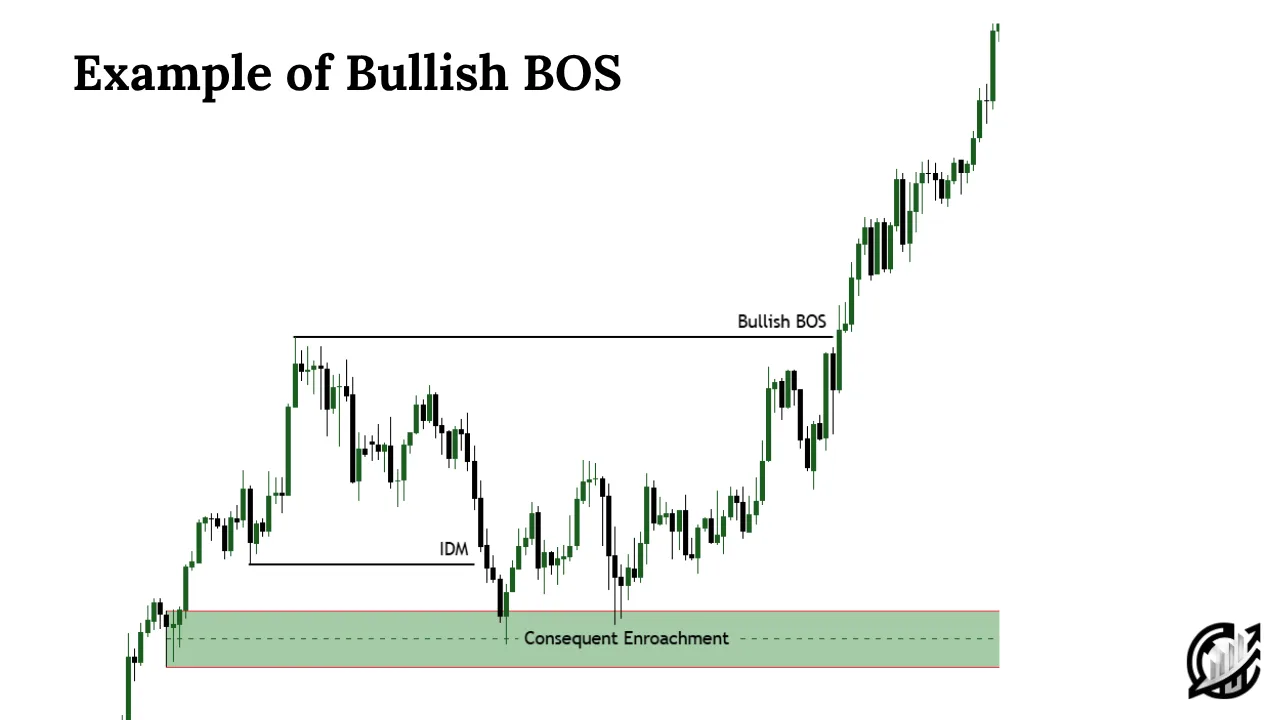
A break of structure is an event where the market price breaks previous major swing point (swing high or low) that defines current trend. Break of structure is a signal for trend continuation and confirms that the prior trend is still intact.
In bullish market, price makes higher highs and higher lows. A break of structure occurs when price closes above the previous swing high. This action confirms that buyers still dominate and the uptrend continues.
In bearish market, price makes lower lows and lower highs, A break of structure occurs when price closes below the previous swing low. This action confirms sellers are still in control.
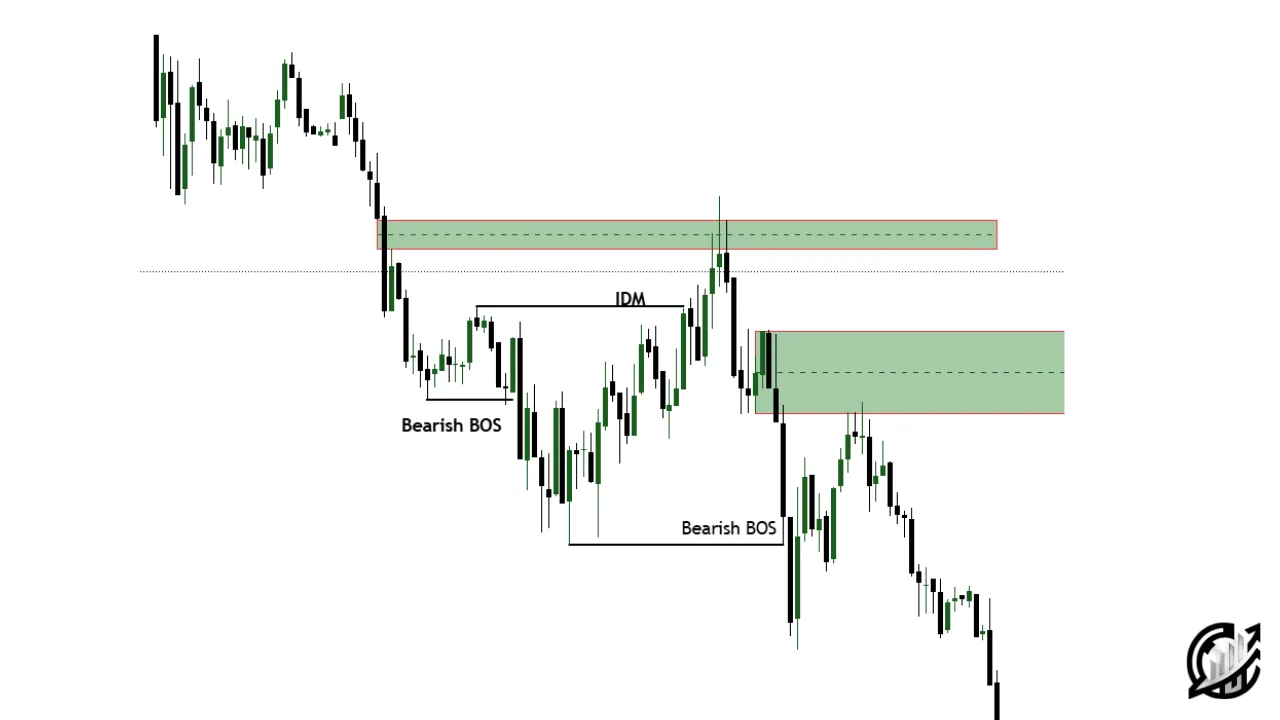
The break of structure is validated only when price closes beyond the structure (not just by wick) with strong, impulsive candlestick showing institutional participation.
What is Change of Character?
In SMC, change of character signals a potential shift or weakening on the current market trend. It occurs when the typical price swing pattern that defined the existing trend is violated. This price action suggests a possible trend reversal.
In an uptrend, the pattern is higher highs and higher lows. In that case, change of character is recognized when price breaks below the most recent higher low. This shows that buyers are losing control. After this if price retraces but fails to create a new higher high and forms a lower high, it indicates sellers are taking control.
In a downtrend, price normally makes lower lows and lower highs. In that case, change of character is recognized when price breaks above the most recent lower high. If price retraces and fails to form a new lower low, instead making a higher low, this signals that uptrend is establishing.
SMC experts warns that if the overall directional bias is against the trend, then take this as warning rather than a complete reversal confirmation. There is a possibility the existing trend might be weakening or ending.
Conceptual Difference Between BOS and CHOCH
In the realm of price action and SMC trading, the terms BOS and CHOCH are often encountered. Understanding their distinction is important for traders aiming to read the market accurately and optimize their entries and risk management.
Market Phase: Continuation vs Potential Reversal
The break of structure occurs during continuation phase of the market. It confirms the potential of the existing trend. It also confirms that institutional players continue to drive the price in the same direction.
In an uptrend this would mean price making higher highs & lows, while, in downtrend, lower lows & highs persist. The BOS confirms these movements by breaking key previous swing highs and lows. This signals confidence in the trend’s sustainability.
On the other hand, the CHOCH signals a potential trend reversal. It indicates that the current trend is weak and market is preparing to change direction. CHOCH is identified when price breaks a previous swing in the opposite direction of the trend. This break is an early warning that the established trend may be losing strength.
Direction of Price Movement
In BOS price breaks beyond a key swing high or low that aligns with the prevailing trend. In a bullish market, price closes decisively above the last swing high. It reinforcing bullish momentum. In a bearish market, the price closes below the last swing low. It confirms continued selling pressure.
CHOCH is characterized by price breaking against the trend’s typical swing direction. In a bullish market, CHOCH occurs when price breaks below the most recent higher low. This break suggests that buying pressure is weakening. In a bearish market, CHOCH is evident when price breaks above the most recent lower high. It indicates that sellers’ control is weakening.
Confirmation Through Candle Behavior
BOS requires a strong candle close beyond the previous swing high or low. This type of candle is also known as displacement candlestick. Remember a simple wick piercing candle is not enough. Displacement candle must have a decisive close with a sizable candle body. This confirmation reduces the risk of false breakouts and reassures traders that the trend remains robust.
In contrast, CHOCH is confirmed by the break of the last significant swing in the opposite direction of the trend. This break often appears as a clear close beyond a prior higher low in an uptrend or lower high in a downtrend.
Implications for Institutional Order Flow
Break of structure implies that institutional order flow remains consistent with the current trend. Large players continue to add to their existing positions, driving price progressively in their favored direction.
CHOCH suggest a possible shift in institutional order flow. Institutions may be closing out their positions in the current trend and preparing to reverse or at least pause momentum.
Continuation vs Early Reversal Signals
BOS is ideal for trend-following trades. Traders use BOS to confirm that the market continues in their existing direction. Trend-following strategies provide reliable entry points for adding to or initiating positions aligned with the trend.
CHOCH serves as an early signal for possible reversals or deeper pullbacks. It warns traders that the trend may be faltering, signaling caution or preparation for counter-trend trades. For secure trading, additional signals like BOS in the opposite direction can be used to plan trades.
How CHOCH Develops After a BOS?
In live trading markets, you should be aware about the higher timeframe market structure. Understanding how CHOCH forms after a break of structure (BOS) is essential for interpreting the life cycle of a trend.
In bullish market, price breaks the previous highs and forms higher highs and higher lows. In bearish market, it breaks previous lows and creates lower low and lower high. These price move represent rhythm in price action.
Trends take time to develop. Before continuing its prior trend, the market often engineers liquidity traps known as inducements. It is common that before continuing or reversing a trend, market sweeps liquidity.
CHOCH signals a trend reversal. This is where trend ends. In CHOCH, price shows counter trend move which breaks recent swing points. In simple words, CHOCH breaks
Final Thoughts
In simple terms, break of structure is used to interpret the life cycle of a trend. Break of structure defines the continuation of bullish and bearish trend. On the other hand, CHOCH is used to define the transition of existing trend. Change of character is confirms the trend reversal.
For SMC and ICT traders, these concepts are important to understand. These concepts help traders understand market structure without creating any confusion.

I’m Abdullah Shah, a content writer with three years of experience in crafting engaging and informative content. My background in market analysis complements my work, allowing me to create content that resonates with audiences. I’m also a seasoned practitioner in the forex and crypto markets, with a strong foundation and deep interest in finance. My passion for the financial world drives me to produce content that is both insightful and valuable for those interested in understanding market trends and financial strategies.