After spending meaningful time in studying ICT’s smart money concepts, you have probably come across the idea that institutional traders leave footprints in the market. Most of those footprints are visible in the form of ICT PD arrays.
However, there are hidden order block as a PD array that most retail traders ignore.

Table of Contents
What is an ICT Hidden Order Block?
The ICT hidden order block is a price area that does not register as an obvious structure on a higher timeframe chart. These OBs sometime referred to as a hidden OB or concealed institutional zone.
Unlike a formal order block, which is visible clearly with identifiable candle preceding a strong impulse move, the hidden order block is embedded within candlestick wicks.
In simple terms, what appears as a single wick on a daily or weekly chart is actually an entire order block on a lower timeframe. The wick is a compression of lower timeframe price action. Within that price action, institutional orders were placed, executed, and defended.
This is why it qualifies as a secret PD array.
Logic Behind Wick-Based Institutional Zones
Michael place special attention on premium and discount wicks. In his lectures, he treated wicks as gaps.
To understand why wicks carry institutional significance, it helps to think about what a wick actually represents. When price pierces a level and then rapidly rejects, it means orders at that zones were absorbed or filled quickly enough to push price back in the opposite direction.
All that price delivery is not random. That is a deliberate response from participants with substantial capital.
In ICT framework, smart money concepts consistently emphasize that liquidity exists above old highs and below old lows. Wicks are frequently the mechanism through which that liquidity is collected before price resume its intended direction.
The hidden order block takes this one step further by showing that the wick itself marks a definable zone of concealed institutional activity.
How to Identify a Bullish Hidden Order Block?
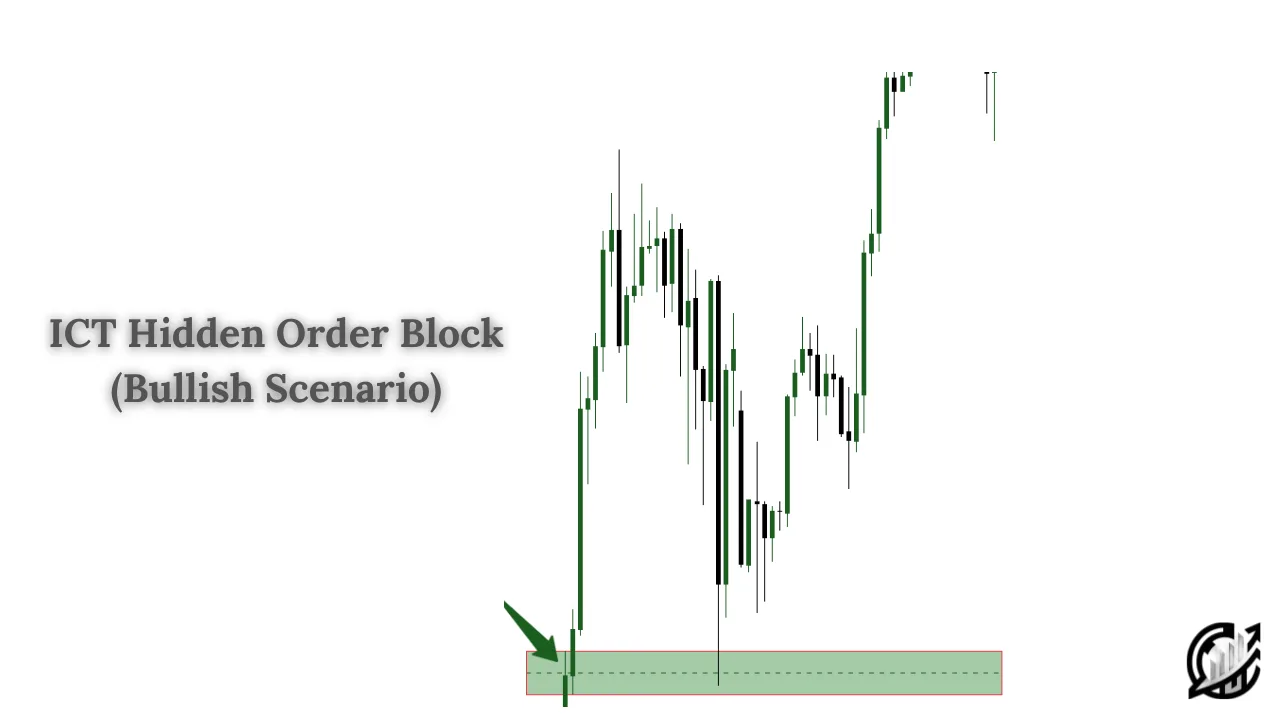
The bullish hidden order block forms when two consecutive bullish candlesticks produce overlapping wicks in a specific configuration.
The first bullish candle forms an upper wick, meaning price pushed upward beyond the candle’s body but closed lower, leaving that wick exposed.
The second bullish candle forms a lower wick that overlaps with the upper wick of the first candle.
The entire wick range from the low of the second candlestick to the high of the first candlestick is then marked as the bullish hidden OB zone.
The overlap tells you that price on lower timeframe creates a swing low. On the lower timeframe, a full order block forms during the retracements. On the higher timeframe, you see two wicks.
Practical Identification Checklist
- Both candlesticks must be bullish (close above the open)
- The first candlestick must have a defined upper wick.
- The second candlestick must have a lower wick that penetrates the first candle’s wick range.
- The zone extends from the second candle’s wick low to the first candle’s wick high.
How to Identify a Bearish Hidden Order Block?
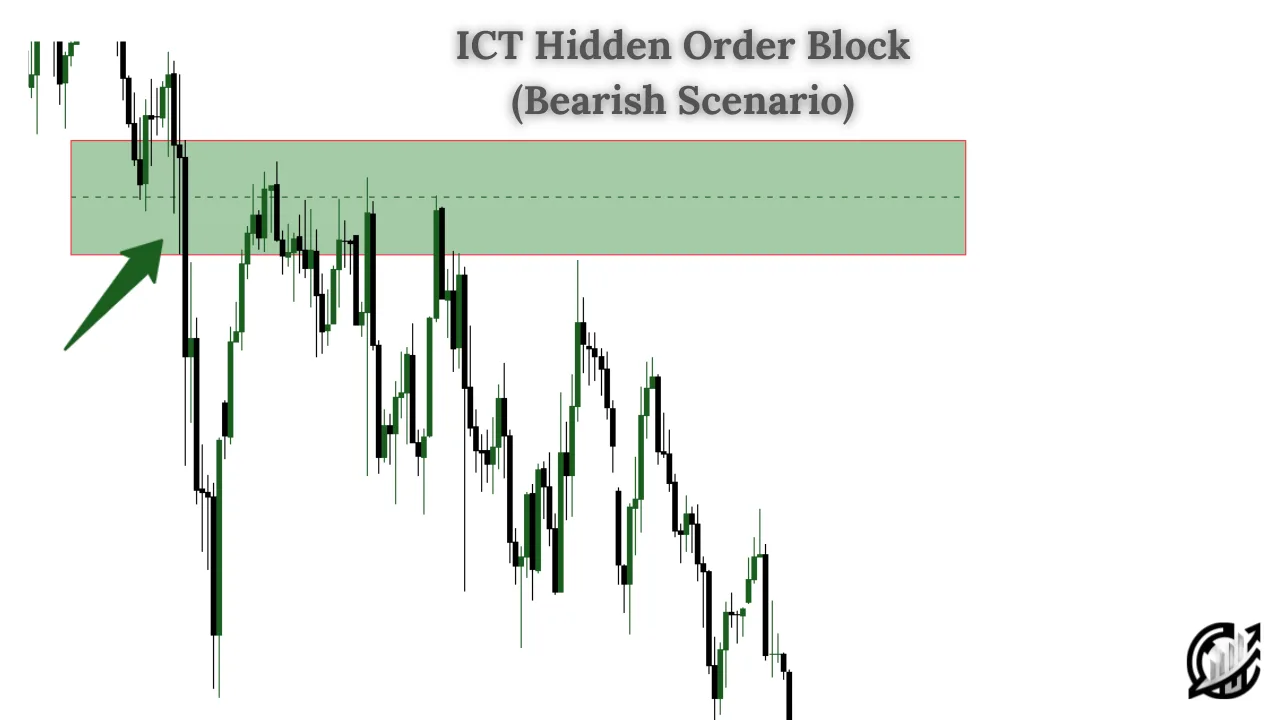
The bearish hidden order block forms when two consecutive bearish candlesticks produce overlapping wicks in a specific configuration.
The first bearish candle forms a lower wick, meaning price pushed downward below the candle’s body but closed higher, leaving that wick exposed.
The second bearish candle forms an upper wick that overlaps with the lower wick of the first candle.
The entire wick range from the high of the second candlestick to the low of the first candlestick is then marked as the bearish hidden OB zone.
The overlap tells you that price on lower timeframe creates a swing high. On the lower timeframe, a full order block forms during the retracements. On the higher timeframe, you see two wicks.
Practical Identification Checklist
- Both candlesticks must be bearish
- The first candlestick must have a defined lower wick.
- The second candlestick must have a higher wick that penetrates the first candle’s wick range.
- The zone extends from the second candle’s wick high to the first candle’s wick low.
Why the Hidden OB matters in SMC?
Standard order block identification tends to draw a lot of attention in ICT traders’ community. However, the hidden order block remains genuinely underutilized.
The hidden OB matters because it is derived from wick overlap rather than a traditional candle body, most traders using basic OB strategies will not have this level marked. When price returns to the zone, you are trading the alongside institutional positioning rather than crowded retail entry levels.
The hidden OB functions as a bridge between timeframes. You mark it on higher timeframe using the wick range, but its origin is on lower timeframe.
With proper hidden OB, the zone has a clearly defined upper and lower boundary. This helps in placement of logical and precise SL. So, we can improve our risk management strategy.
Trading the Hidden OB: A Step-by-Step Approach
Determine the Market Bias
Before marking an ICT PD array, establish whether the market is in a bullish or bearish phase. Look for higher highs and higher lows for bullish bias, or lower lows and lower highs for bearish bias.
Trading the bullish hidden OB in a bearish trend significantly reduces its effectiveness.
Locate the Zone on Higher Timeframe
On your primary timeframe (daily or four-hour), scan for two consecutive candles of the same type (both bullish or both bearish) where the wicks overlap as described above. Mark the full wick range as your hidden order block.
LTF Confirmation
Once price enters the hidden order block zone, drop to LTF like 15-minute or 5-minute chart and look for confirmation signals. Common ICT reversal signals are market structure shift, CISD, or any inverse FVG.
Execute and Manage the Trade
Enter on confirmation with a stop-loss placed just beyond the outer boundary of the hidden order block. For targets, look to the next draw on liquidity.
Hidden Order Block vs. Standard SMC Order Block
As far as visibility is concerned, standard SMC OB is body based and clearly visible. On the other hand, hidden OB is wick-based and require interpretation.
Standard OB is visible on single timeframe. Standard OB require multi-timeframe confirmation. Mostly wicks on higher timeframe can be the minor reversal lower timeframe.
Traders are much concerned with easily visible order block. No doubt its visibility is limited but it is effective for trading.
Common Mistakes When Using Hidden Order Blocks
Not every pair of wicks qualifies. Both candles must be of the same type, and the overlap must be meaningful. The setup must appear within a relevant higher-timeframe context.
The hidden OB does not work in a vacuum. It must align with prevailing price delivery. A bullish hidden OB in a bearish market is a low-probability setup regardless of how clean the wick overlap looks.
Because the zone is partially invisible to most participants, confirmation on the lower timeframe is especially critical. Entering purely on price touching the marked zone without lower-timeframe validation leads to early entries that get stopped before the actual move begins.
Final Thoughts
The hidden ICT OB represents one of its least discussed PD array. It demands a slightly deeper understanding of how higher-timeframe candles are constructed from lower-timeframe price action.
This article is for educational purposes only and does not constitute financial advice. Always conduct your own research and apply proper risk management in live trading environments.

I’m Abdullah Shah, a content writer with three years of experience in crafting engaging and informative content. My background in market analysis complements my work, allowing me to create content that resonates with audiences. I’m also a seasoned practitioner in the forex and crypto markets, with a strong foundation and deep interest in finance. My passion for the financial world drives me to produce content that is both insightful and valuable for those interested in understanding market trends and financial strategies.