Sometimes the market spikes hard in one direction. The move is so sharp and volatile that it seems genuine, but then immediately reversed in the exact opposite direction. This is a trap move of ICT power of three, also known as PO3 and AMD setup. It is a pattern that repeats again and again in the market.
The ICT power of three is a trading framework developed by Michael J. Huddleston, the Inner Circle Trader. The technical framework reveals the three-phase cycle through which institutional money operates every single day.
Once you understand the mechanics behind Accumulation, Manipulation, and Distribution, the market stops looking like chaos and starts revealing a clear, time-based narrative that repeats across forex pairs, gold, indices, and crypto.
Core Concept: ICT power of three reveals that every trading day follows three phases – Accumulation, Manipulation, and Distribution. Smart money engineers these phases to trap retail traders and build liquidity before releasing the real institutional move. Understanding PO3 means trading with the institutions, not against them.

What is ICT Power of Three (PO3)?
The term ‘Power of Three’ refers to the three-phase market cycle that institutional traders and algorithmic pricing systems use to deliver price from one level to another. Each phase serves a specific purpose in the process of institutional position building and execution.
PO3 is a mechanical process that occurs because large institutions cannot execute their enormous orders in a single transaction. They need time to accumulate positions without moving the market against themselves, they need liquidity from retail traders to enter at favorable prices, and they need a controlled delivery of price to take profits. The AMD cycle provides all three.
It is also referred to as AMD setup. It is a trading approach in ICT concepts that breaks down the typical daily price movement into three phases. Timing is crucial to consider. It is combined with three major sessions to derive a better trading strategy. ICT power of three helps traders align their strategies with the behavior of “smart money”.
Wyckoff, in his studies, emphasizes especially on the Accumulation phase of the market. ICT trading does the same in their understanding of the market. This phase usually happens at the beginning of the trading day, especially when the market is ranging in a specific zone (with no clear trend). During this time, BIG MONEY is accumulating their positions. It sets the ground for the next phases.
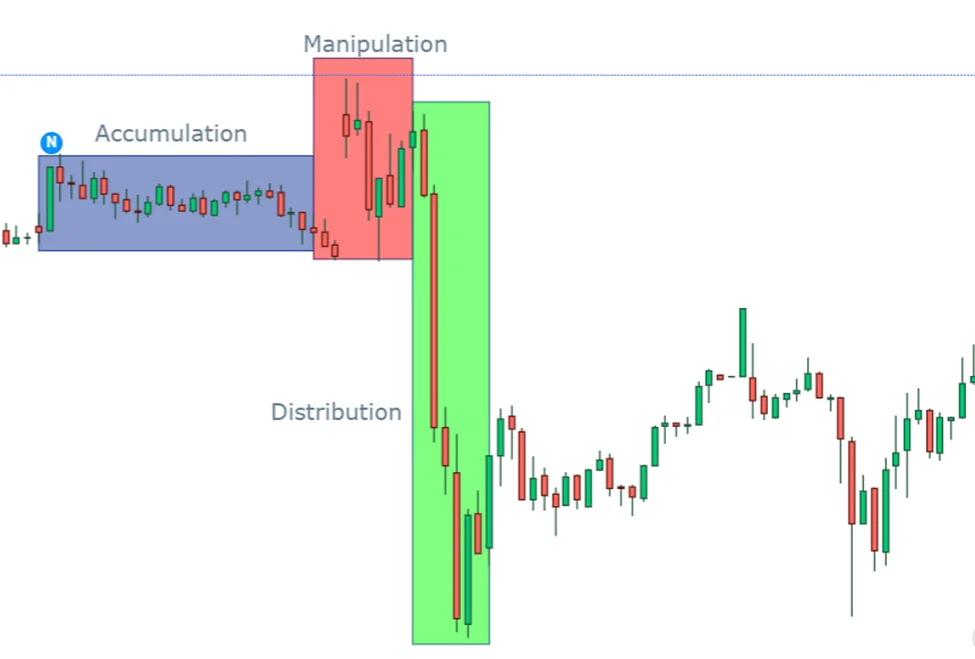
Retailers are mostly unaware about the traps of the market. The manipulation phase occurs when institutions and market makers move the market in the opposite direction. Trap moves are designed to target stop-losses near the level.
In a bullish market, it appears with a sudden down move. In a bearish market, the manipulation phase appears with a sharp upward move. The movement is designed by tricking retail traders into thinking that the market is going bullish. The goal of this phase is to grab liquidity by triggering stop-losses and enticing retail traders to enter positions in the wrong direction.
The distribution phase is the last and complete AMD setup. ICT traders wait for the movement of the phase and capitalize on it. After manipulating retail traders, institutions and market makers cause the market to move in the intended direction.
If the market is manipulated upward, the next move would be the downtrend. If the market is manipulated downward, the next move would be the uptrend movement. This phase usually carries the most momentum and defines the overall market direction for the day.
What are the Three Phases of Power of Three?
The power of three is fractal. This means that it repeats on every timeframe. The same AMD that plays out intraday across Asian, London, and New York sessions also repeats on a weekly scale and even on monthly scale.
Phase 1: Accumulation
In intraday, accumulation is the quietest phase of the PO3 cycle. During the Asian session, prices move within a tight, sideways range. There is no clear directional momentum, no clear trend, and volatility is low. This is a clear sign that smart money is methodically placing orders on both sides of the range.
Phase 2: Manipulation
Manipulation is the phase that destroys retail traders’ accounts more than any other single market behavior. During the London session open, price suddenly breaks out of the Asian session accumulation range. During the manipulation, institutions drive the price lower (on bullish day) below the accumulation and then continue its upward direction. The reverse applies to bearish markets.
Quote: For the manipulation move to be valid within the ICT PO3 framework, it must typically sweep a significant liquidity level – not just the immediate accumulation range boundary.
Phase 3: Distribution
After the manipulation, on a bullish day, during the New York session, smart money reverses the market aggressively to the upside. Price recaptures the accumulation range and breaks above the range high with momentum. The reverse applies to bearish markets.
Entry Signal for Distribution: After the manipulation sweep, drop to the 15-minute chart. Wait for a Market Structure Shift. Once the MSS appears, switch to the 5-minute chart for a precise entry candle. Enter in the direction of distribution with a stop with a stop behind the manipulation wick extreme and target the institutional draw on liquidity.
Timeframe Selection for the AMD Setup
It is the most common question among ICT learners. The answer is that it requires a top-down multi-timeframe approach. Each timeframe serves a specific purpose in the AMD cycle. The table below maps the exact role of each timeframe in the PO3 trading workflow.
| TImeframe | PO3 Purpose | What You Do on This Timeframe |
| Daily / Weekly | Bias and Context | Identify the dominant trend direction. |
| 4-Hour | Structure and Zones | Locate key order blocks, FVGs, and breaker blocks |
| 1-Hour | Phase Identification | Identify the accumulation range. Map where the manipulation spike is likely to target |
| 15-minute | Entry Confirmation | After the manipulation sweep, use the 15M chart to watch for a market structure shift or change of character (CHOCH) that signals the transition into distribution. |
| 5-Minute | Precision Entry | The Lowest recommendation timeframe for PO3 entry candle. |
Top-Down Rule: Always start from the daily chart and work downward. Never start analysis on the 5-minute is for execution only. Every trading decision must be based on a broader trend.
Bullish Power of Three (PO3)
At the start of the trading session, prices often range near the opening price, indicating that smart money is accumulating buy positions. In this phase, marking is calm with no clear indication of trend movement. This phase is a phase of confusion for retail traders. They hesitate to make decisions.
Institutions and big money then manipulate the market by creating a sharp sell move below the opening price. This downward spike is designed to induce retail traders into thinking that the market is reversing or breaking out to the downside. The price drops below old lows, which many retail traders mark as potential support levels.
Retail traders view this sudden move as a breakout to the downside. They believe the price will continue to drop, they enter short positions (sell positions) in the market. Retail traders with assets bought in the accumulation phase have their stop-loss orders triggered as the price dips below old lows, which neutralizes their buy positions. This action provides liquidity to the smart money.
With liquidity now engineered and priced at a discount, smart money begins to buy heavily. This buying pressure causes the market to reverse direction and move upwards, starting the distribution phase.
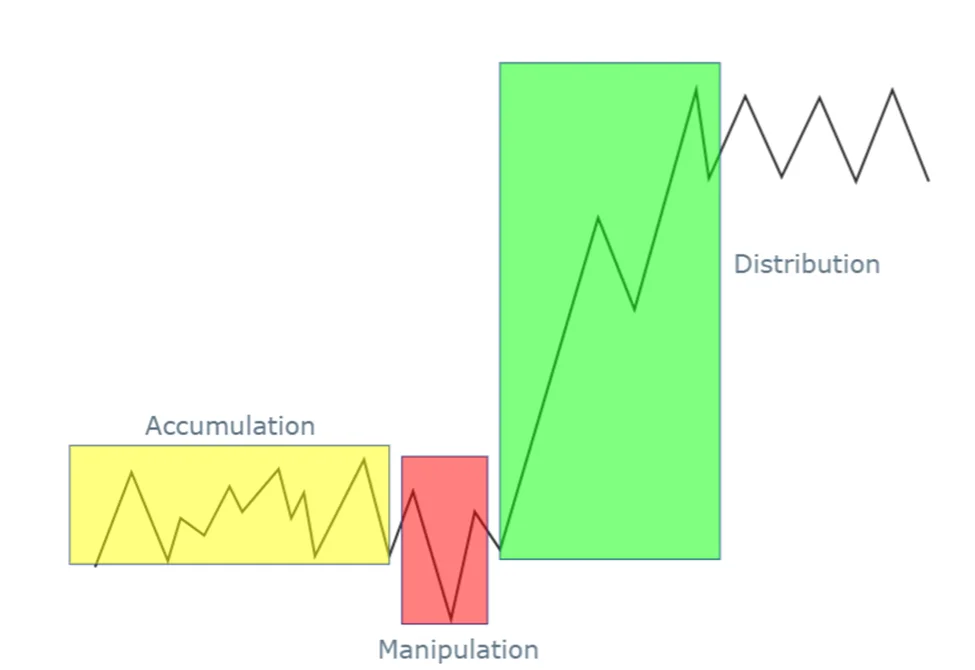
The smart money’s target is the old highs, where stop-loss orders from retail traders who went short earlier are likely sitting. Once the price reaches this level, it sweeps these stops, triggering a final burst of upward momentum as retail sellers cover their positions.
Bearish Power of Three (PO3)
As the day begins, prices accumulate near the opening price. In the accumulation phase, smart money is building their sell positions. The market is consolidated in a tight range giving no trend. Institutions are quietly accumulating their sell positions, anticipating a downward move later in the day. They are aware that liquidity (stop losses) lies above key levels like previous highs.
After the accumulation phase, smart money initiates a sharp bullish move above the opening price. This false move is designed to manipulate retail traders into thinking that the market is breaking out to the upside.
Retail traders with short positions now see their stop-loss orders (buy stops) triggered as the price goes above old highs. This neutralizes their sell positions and provides additional liquidity to smart money.
Institutions engineers this fake out above the opening price. They target the old highs and trick retail traders into buying an asset. Once liquidity has been gathered, smart money steps in to sell at a premium, and capitalize on market movement.
As institutions add to their sell positions, the market starts its distribution phase. In this phase, the market reverses direction and moves in the real bearish trend. The move accelerates as more retail traders who were trapped in long positions are forced to sell, driving the price down further.
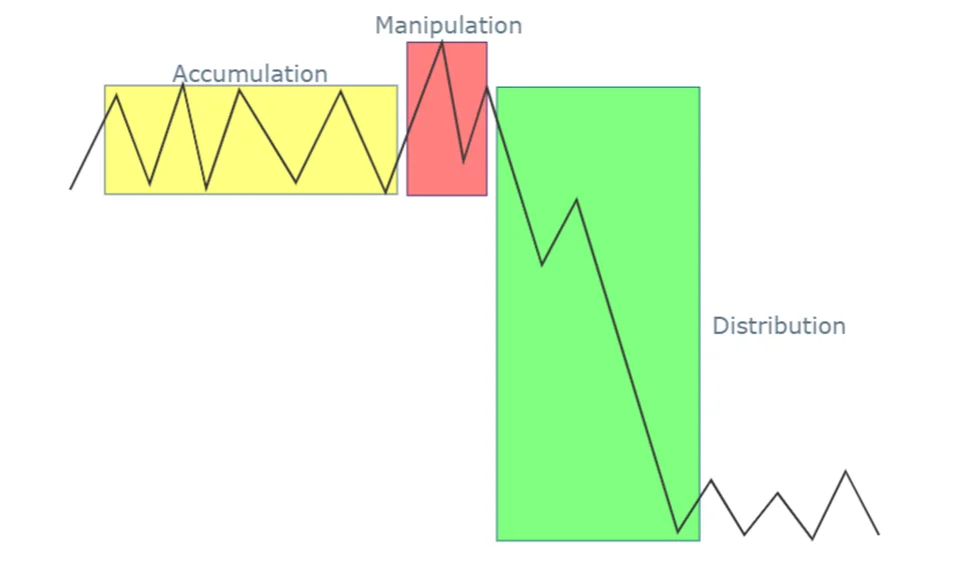
By recognizing these phases in real time, traders can better time their entries and exits, and avoid being caught on the wrong side of the market. This strategy also emphasizes how institutional players control price movements by exploiting retail traders’ emotions and stop-losses.
Final Note
Trading financial markets, including forex, stocks, and other assets, carries a significant level of risk and may not be suitable for all investors. Market conditions can be volatile, and there is always the possibility of sustaining substantial losses, potentially exceeding your initial investment. It’s crucial to only trade with money you can afford to lose.

I’m Aatiq Shah, a dedicated forex and crypto market practitioner with three years of hands-on experience. Currently, I’m working as a Financial Manager. My journey in the world of finance has equipped me with the skills and knowledge needed to navigate the complexities of the forex and crypto markets.