Every trade you ever place starts with one small choice: Do you want it done now, or do you want it done at your price?
That single decision is the whole idea behind the market order vs limit order question. Get it right, and you save money, avoid nasty surprises, and trade with more confidence. Get it wrong, and you might pay far more than you planned, or miss a trade entirely.
In this guide, we’ll explain both order types in everyday language, show why traders call them aggressive and passive, and help you decide which one fits each situation.
First, a Quick Look at the Order Book
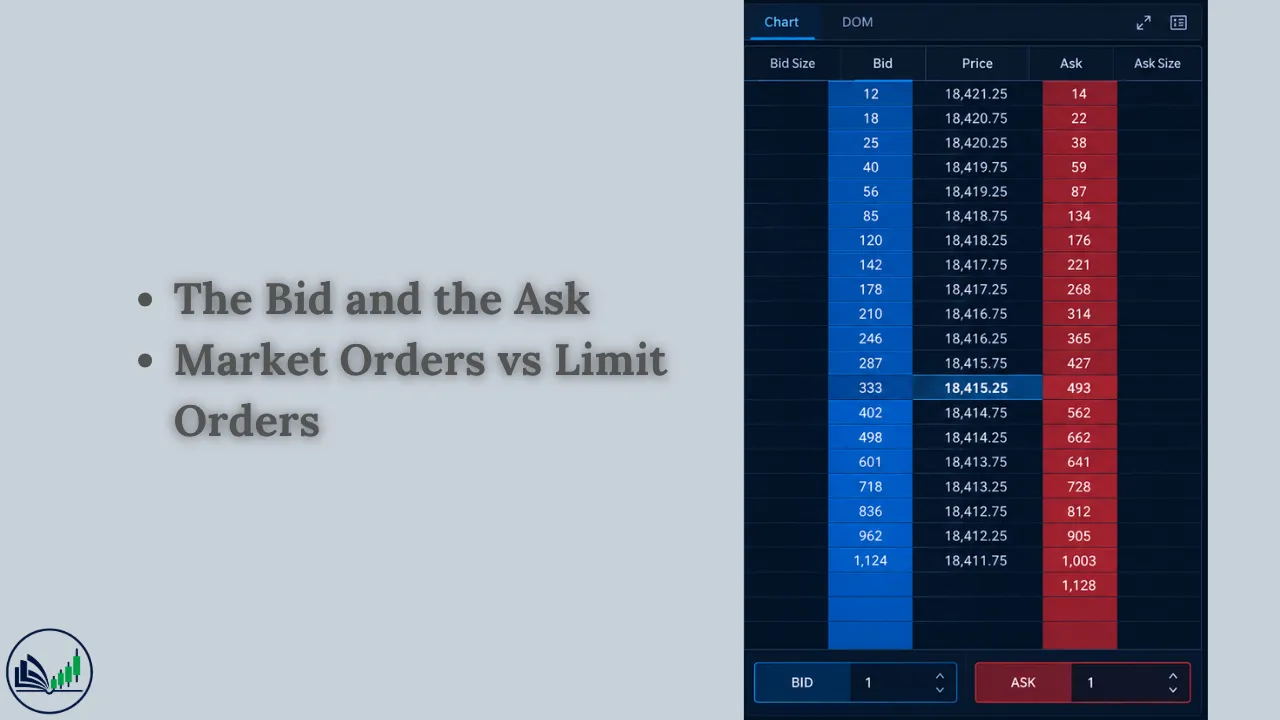
Before comparing the two, picture the order book as a noticeboard at a market stall.
- On one side, buyers pin notes saying, “I’ll pay this much.” The highest of these is the bid price.
- On the other side, sellers pin notes saying, “I’ll sell at this much.” The lowest of these is the ask price.
The small gap between the best bid and the best ask is the bid-ask spread. Keep this picture in mind, because market and limit orders interact with this noticeboard in opposite ways.
What Is a Market Order?
A market order is an instruction to buy or sell immediately at the best price currently available.
You’re telling your broker, “I don’t care about the exact price. Just get me in (or out) right now.”
- A market buy takes the lowest ask price.
- A market sell takes the highest bid price.
Why Market Orders Are Called “Aggressive”
A market order doesn’t wait on the noticeboard. It walks straight up and grabs a note that’s already there. Because it removes available orders from the book, it takes liquidity. That’s why traders call it an aggressive order and the trader a liquidity taker.
Aggressive orders are also what actually move price. When enough market buy orders eat all the sell notes at one level, the price has to tick up to the next seller.
💬 Quote: “Speed costs money. How fast do you want to go?” — Popular saying among traders and engineers alike
What Is a Limit Order?
A limit order is an instruction to buy or sell only at a specific price or better.
- A buy limit is placed at or below the current price. It fills only at your price or lower.
- A sell limit is placed at or above the current price. It fills only at your price or higher.
You’re telling your broker, “Here’s my price. I’ll wait until someone agrees to it.”
Why Limit Orders Are Called “Passive”
A limit order pins its own note on the noticeboard and waits patiently. It adds liquidity to the market, giving other traders something to trade against. That’s why it’s called a passive order, and the trader a liquidity provider or maker.
Passive orders don’t push price around. They sit quietly until an aggressive order comes along and hits them.
💡 Tip: An easy way to remember it: market orders take, limit orders make. Takers pay for speed. Makers are rewarded for patience.
Market Order vs Limit Order: Side-by-Side
| Feature | Market Order (Aggressive) | Limit Order (Passive) |
|---|---|---|
| Main priority | Speed | Price |
| Execution | Almost guaranteed | Not guaranteed |
| Price | Not guaranteed | Guaranteed (or better) |
| Role in order book | Takes liquidity | Adds liquidity |
| Effect on price | Can move price | Doesn’t move price directly |
| Slippage risk | Yes | No |
| Typical fees (crypto, some brokers) | Higher “taker” fees | Lower “maker” fees or rebates |
| Best used when | You must act right now | You have a target price and time |
The Hidden Cost of Market Orders: Slippage
The biggest danger of a market order is slippage: the gap between the price you expected and the price you actually got.
How Slippage Happens
Imagine you want to buy 1,000 shares. The best ask shows only 200 shares at $50.00. Your market order buys those 200, then moves up to the next level and buys at $50.05, then $50.10, and so on until all 1,000 are filled. Your average fill price ends up higher than the $50.00 you saw on screen.
Slippage gets worse when:
- The market is thin (few orders in the book)
- Volatility is high, such as during major news releases
- You trade a large size compared to available liquidity
- The market opens with a price gap
💡 Tip: Before hitting a market order in a quiet or fast-moving market, glance at the spread. A wide spread is a warning light that slippage could be costly.
The Hidden Risk of Limit Orders: Missing the Trade
Limit orders protect your price, but they have their own weakness: they may never fill.
Common Reasons a Limit Order Doesn’t Fill
- Price never reaches your level. If you place a buy limit at $48 and the stock bounces at $48.10, you’re left watching it climb without you.
- Queue priority. Orders at the same price usually fill in the order they arrived. If many traders are ahead of you in the line, price may touch your level and leave before your turn.
- Partial fills. Sometimes only part of your order gets filled before price moves away, leaving you with a smaller position than planned.
This is the trade-off in a nutshell: market orders risk a bad price; limit orders risk no price at all.
💬 Quote: “It never was my thinking that made the big money for me. It always was my sitting.” — Jesse Livermore, as told in Reminiscences of a Stock Operator (1923)
Fees: Why Makers Often Pay Less
Many exchanges, especially in crypto and some futures and stock venues, use a maker-taker fee model.
- Takers (market orders and limit orders that fill instantly) pay a higher fee, because they remove liquidity.
- Makers (limit orders that rest in the book) pay a lower fee, and sometimes even earn a small rebate, because they add liquidity.
For an occasional investor, the difference may be tiny. But for an active trader placing dozens of trades a day, choosing passive orders can add up to real savings over a year.
💡 Tip: Check your broker or exchange fee schedule. Some platforms offer a “post-only” option that guarantees your limit order adds liquidity and is never charged a taker fee.
Where Do Stop Orders Fit In?
Many beginners confuse limit orders with stop orders. They work in opposite directions.
Stop (Stop-Market) Order
A stop order sits dormant until price reaches a trigger level. Once triggered, it becomes a market order. Traders use it mostly as a stop-loss to cap losses. Because it turns aggressive, it can suffer slippage in fast markets.
Stop-Limit Order
A stop-limit order also waits for a trigger, but once triggered, it becomes a limit order instead. This protects your price, but if the market gaps past your limit, the order may not fill, which can leave a losing trade open.
| Order Type | Trigger? | Becomes | Main Risk |
|---|---|---|---|
| Stop (market) | Yes | Market order | Slippage |
| Stop-limit | Yes | Limit order | No fill |
When Should You Use a Market Order?
Market orders make the most sense when getting filled matters more than the exact price:
- Exiting a losing trade fast when you need out right away
- Highly liquid markets like major stocks, index futures, or large crypto pairs, where spreads are tight
- Small position sizes that won’t eat through the order book
- Breakouts where waiting might mean missing the move entirely
When Should You Use a Limit Order?
Limit orders shine when price matters more than speed:
- Buying at support or selling at resistance levels you planned in advance
- Thinly traded assets such as small-cap stocks or less popular crypto coins
- Large orders that could cause heavy slippage
- Volatile periods, like market open or news events, when prices jump around
- Taking profit at a pre-set target while you’re away from the screen
💡 Tip: If you want speed but some price protection, try a marketable limit order: a buy limit placed slightly above the current ask (or a sell limit slightly below the bid). It usually fills right away, but it can never fill worse than your chosen limit.
Aggressive vs Passive: What It Tells You About the Market
Understanding these two order types isn’t just about placing your own trades. It also helps you read other traders.
When aggressive buyers dominate, repeatedly lifting the ask, price tends to rise. When aggressive sellers dominate, repeatedly hitting the bid, price tends to fall. Meanwhile, large passive orders resting in the book can act like walls that slow or stop price.
This is the foundation of order flow analysis. Every candle on your chart is the result of a tug-of-war between aggressive takers and passive makers. Knowing which side is pushing gives you valuable context.
Common Mistakes Beginners Make
- Using market orders on illiquid assets. This is how small traders get surprisingly bad fills.
- Placing market orders at the market open. Prices and spreads can be wild in the first minutes.
- Setting limit orders too far away and then chasing price with a market order out of frustration.
- Forgetting open limit orders. A forgotten good-till-cancelled (GTC) order can fill weeks later when you no longer want it.
- Assuming a stop-limit always protects you. In a sharp gap, it may not fill at all.
Final Thoughts
The market order vs limit order choice comes down to one honest question: what matters more right now, speed or price?
Market orders are aggressive. They guarantee action, take liquidity, and can cost you through slippage. Limit orders are passive. They guarantee your price, add liquidity, and may leave you waiting on the sidelines.
Smart traders use both. They reach for market orders when they must act and limit orders when they can afford patience. Master this simple choice, and you’ll trade more cheaply, more calmly, and with a much clearer view of how the market really works.

I’m Abdullah Shah, a content writer with three years of experience in crafting engaging and informative content. My background in market analysis complements my work, allowing me to create content that resonates with audiences. I’m also a seasoned practitioner in the forex and crypto markets, with a strong foundation and deep interest in finance. My passion for the financial world drives me to produce content that is both insightful and valuable for those interested in understanding market trends and financial strategies.