Foreign Exchange Market operates twenty-four hours a day, and five days a week. Forex market is global and decentralized, and operates with different financial centers opening and closing. Among these, the Asian trading session is equally important for traders who want to take advantage of early market sentiment.
Asian session is characterized of low volume and volatility. However, traders often find high-probability trades in less volatile market.
This article explores understanding and essentials of Asian Session, and strategies and pairs used by smart money traders in trading Asian session.
Asian Session Tracker | Live
Tokyo session status, the Asian kill zone, and the Sydney/Tokyo overlap — live, in your own timezone.
Session and kill-zone times are calculated live from each city’s real current UTC offset, so Daylight Saving Time — including Australia’s reversed, southern-hemisphere schedule — is handled automatically. Educational reference only — not trading advice.
When the Asian Session Runs
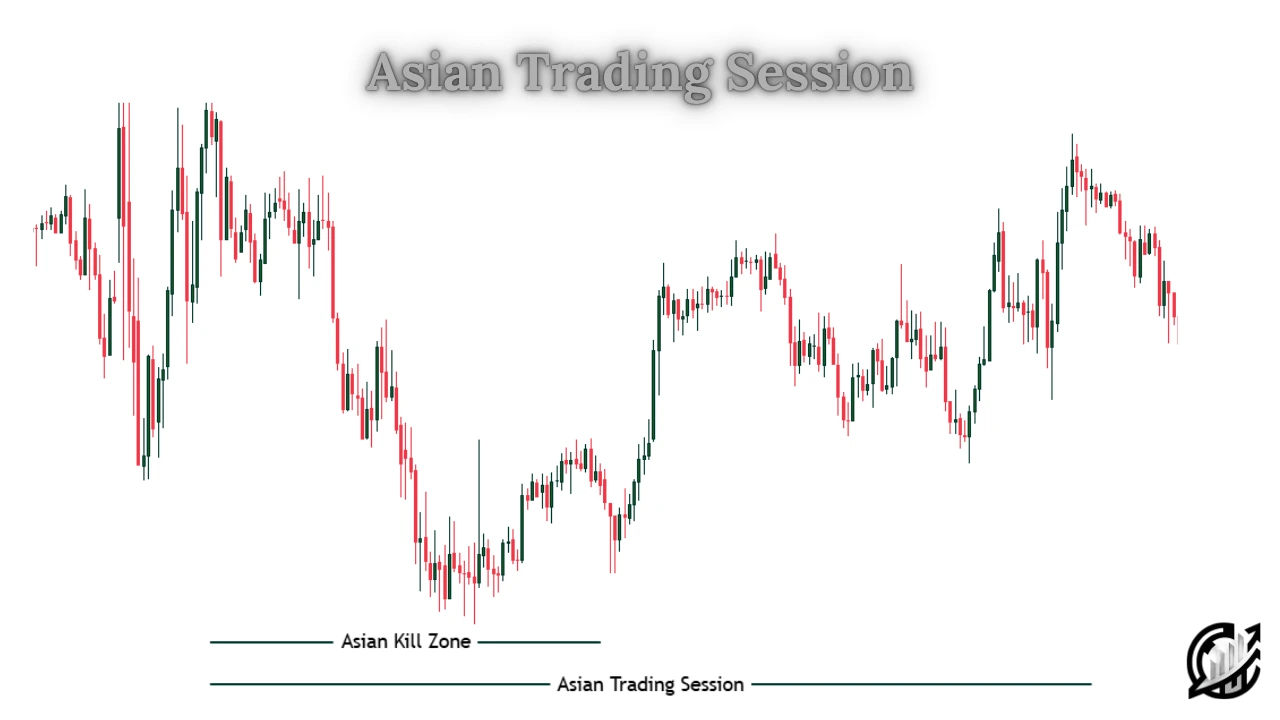
In New York time, the Asian trading session typically runs from 7:00 PM to 4:00 AM. Liquidity actually starts building a little earlier than that, right around the Sydney open, before the session moves into its more active phase once Tokyo comes online.
This New York-time framing matters more than it might seem. Because trading terminology in the SMC and ICT space is conventionally tracked against New York’s clock, referencing the Asian session this way keeps it consistent with how kill zones, macros, and other session windows get discussed everywhere else in this kind of content — rather than switching between GMT, JST, and half a dozen other reference points depending on the source.
Key financial centers operate in Tokyo (Japan), Sydney (Australia), and Hong Kong and Singapore. Tokyo is the most influential player in this session. Sydney opens earlier and influences initial price movement. As far as Hong Kong and Singapore is concerned, its major financial hub contributing to liquidity and volume.
What Makes the Asian Session Different
Lower volatility and lower volume are the two words that define this session more than anything else. Price action during Asian hours tends to move slower and tighter than what traders see once London or New York takes over. That’s not a flaw — it’s simply a different kind of session, one that rewards a different kind of trading.
Being the first trading session of week, the Asian session reacts to weekend news (mostly geopolitical or economic events), opening of the global equity and bond markets, and economic releases from countries like Japan, Australia, and China.
Price action is also notable in this session. Though the price movements tend to be more range-bound, Tokyo session often sets the initial trend or price bias for the day. Traders can often see consolidations or setups for breakouts that occur in the London Session.
Asian Session Kill Zone
This concept is highly influential in trading. Although market is less volatile, but, in kill zone, market reacts violently and show the appearance of volume. This concept is popular among ICT traders. Asian kill zone is timed between 7:00 PM to 11 PM New York time.
Asian kill zone identifies window of opportunities within the session. Market tends to establish a tight range during this kill zone. Price often sweeps stops just above and below the Asian range.
This liquidity sweep is designed to trap traders who enter prematurely. These traps set the stage for more significant moves during the London Open Kill zone.
Apart from this general perception of market structure during Asian kill zone, traders must analyze market structure on higher timeframes. As an SMC trader, we must look for the session highs and lows, swing highs and lows, break of structure, and change of character. This confirms direction of the move.
Best Currency Pairs
The most liquid pairs during this window are the ones tied directly to the region’s own currencies: USD/JPY, AUD/USD, and NZD/USD, along with cross pairs like AUD/JPY and EUR/JPY. These pairs see the deepest participation while Tokyo and the broader Asia-Pacific region are active, which generally means tighter spreads and more reliable price behavior than trying to trade a European or American pair during hours when its home market is asleep.
The Japanese Yen is one of the most traded currencies due to Japan’s strong economy. There are other factors like export-focused industry and active retail investor base. During the trading session, JPY pair see tighter spreads and better execution due to higher liquidity.
Characteristics of Asian Trading Session
Along with weaknesses, there are factors that can contribute better opportunities. There are characteristics of Asian session that a trader must consider before trading Asian session.
One of the characteristics is its lower volatility. In Asian Session, price movement generally exhibit slower price action and tight ranges compared to London or New York session. This factor makes it ideal for range traders, those who prefer less volatile markets.
Most of the time, market consolidates during the Asian Session hours before breaking out during the London open. This gives opportunities for traders to anticipate moves based on Asian session highs and lows.
Since the volume is relatively low, price action during the Asian session tends to respect supply and demand zones better. As an SMC trader, you can use candle range concept for precision trading in narrow range markets.
What are the Best Trading Strategies used in the Asian Session?
Trading strategies depends on traders’ selection. Whether you follow indicator-based trading or price action, it should be aligned with your trading psychology. The following are the strategies mostly preferred in Asian session: Range-based trading, breakout trading, and news-based trading.
When price moves between tight supply and demand zones, range trading is highly effective. Since price tends to consolidate rather than trend, buying near the bottom of the session’s established range and selling near the top is a natural approach — as long as the range itself is clearly defined and not just noise.
As the London Session nears, liquidity and volume increases, leading to breakouts from the Asian range. This strategy leans directly on the Asian session’s tendency to build a range: mark the high and low set during Asian hours, then watch for London to break through one side of that range as its own session opens. The break itself, especially with a pickup in volume behind it, is often treated as the real signal — rather than trying to guess the breakout direction in advance.
High-impact economic events from Japan, Australia, or China can create sharp moves. Around scheduled releases from Japan, Australia, or China, some traders shift away from range logic entirely and trade the volatility spike directly, treating the news event itself as the catalyst rather than the session’s usual quiet rhythm.
Reading the Asian Session Through an SMC Lens
For traders applying Smart Money Concepts, the Asian session takes on an additional role beyond just “the quiet session.” The highs and lows it establishes function as liquidity pools — levels where resting orders accumulate while the session stays range-bound. Those pools are exactly what later sessions frequently target: London often sweeps the Asian high or low before revealing its real direction, and New York can do the same to whatever London just established.
This is also where the Candle Range Theory concept connects directly to the Asian session. A higher-timeframe candle that forms largely across Asian hours defines a range in exactly the way CRT describes — and a sweep of that range, followed by a move back toward the opposite side, is one of the more common CRT setups traders watch for once London opens.
Track the Asian Session Live
Reading about session hours is one thing. Knowing exactly where you are inside the session, in your own timezone, right now, is another. That’s what the Asian Session Tracker is built for.
The tool shows three things simultaneously, all updating live:
- Tokyo session status — whether the core Asian session is currently open or closed, with a running countdown to whichever comes next.
- The Asian Kill Zone — the narrower, higher-liquidity window inside the broader session, anchored to New York time the same way kill zones are tracked everywhere else on this site.
- The Sydney/Tokyo overlap — the window where both Sydney and Tokyo are trading at once, which is where the session’s earliest liquidity genuinely starts building, exactly as described above.
Pros and Cons of Trading Asian Session
The following are pros of Asian Session:
- It has lower volatility which reduces the risk of large whipsaws.
- It is suitable for part-time or night-time traders in Asia-Pacific.
- It is easier to trade with small accounts due to tighter ranges.
- It prepares the ground for setups in London session.
The following are the cons of Asian Session:
- It has low volatility and can often lead to false breakouts.
- It may require more patience because price moves slowly.
- There are limited trading opportunities.
Key Tips for Asian Session Traders
The following are the tips for Asian Session traders:
- Avoid trading during market open gaps, especially the first 15-30 minutes of the Sydney or Tokyo open
- Focus on pairs like JPY, AUD, and NZD pairs where liquidity is higher.
- Watch for Asian Session high and low levels. These levels often serve as liquidity zones in later sessions.
- Try to find trade but do not force the market. If market is flat, wait for better trade setups.
- If possible, use tools like ADR (Average Daily Range) to manage expectations for pip movements.
Final Note
Asian trading session might be quieter than its counterparts. However, it provides valuable trading opportunities only if you are disciplined trader. Try to align your trading psychology and strategy for better results.
Financial market’s trading carries risk. Try to consult financial advisor before trading the markets. Always risk the capital that can afford to lose. This writing is for educational purpose only. Conduct your own research before investing and trading.
FAQs
What are the timings of Asian Trading Session?
The Asian trading session typically starts at 7:00 PM and ends at 4:00 AM New York. Liquidity building starts at Sydney open.
Which currency pairs are most active in the Asian session?
USD/JPY, AUD/USD, NZD/USD, and cross pairs like AUD/JPY, and EUR/JPY are the most liquid pairs.
Is the Asian session good for beginners?
Technically, it is the most favorable for beginner forex traders. Its lower volatility and technical price movement make it ideal for beginners.
What is the best strategy for the Asian session?
Range trading and London breakout setups work best due to calm structured price movements.
Do fundamentals matter in the Asian session?
Yes, it works accurately in the market session. Economic news from Japan, Australia, or China can significantly move the currency pairs.

I’m Abdullah Shah, a content writer with three years of experience in crafting engaging and informative content. My background in market analysis complements my work, allowing me to create content that resonates with audiences. I’m also a seasoned practitioner in the forex and crypto markets, with a strong foundation and deep interest in finance. My passion for the financial world drives me to produce content that is both insightful and valuable for those interested in understanding market trends and financial strategies.