Being induced on the wrong side of the market is the most frustrating experience in trading. Institutions and Big money often induce traders to enter, and then they trap them and move the market against them. Institutions trap retail traders on the wrong side of the market.
This idea is rooted in the belief that financial markets are highly influenced by the actions and strategies of institutions and “Big Money”. This is because institutions are privileged to see the data that is not accessible to retailers. The concept of “Inducement” is broad in trading markets (forex and other financial markets).
With the help of SMC and ICT concepts, traders can uncover the inducement zones laid by institutions. Understanding inducement in trading can explain why these traps occur, and how to avoid falling into the trap again.
Table of Contents
What is Inducement (IDM) in SMC Trading?
In general, inducement (IDM) refers to the notion of persuading someone to do something. The same applies in the trading market (forex and other financial markets). Inducement refers to the process by which market movements encourage traders to take positions that are designed to fail. The idea behind inducement is that institutions often manipulate price movements. This attracts a wide variety of traders and traps them in wrong trades.
In SMC and ICT trading, understanding the concept practically enhances trading decisions and helps them align with the strategies of institutional players rather than being trapped by them. ICT concepts are helpful in understanding institutional mindset. The tips and tricks of ICT concepts help us be aware of inducements laid down by institutions.
One thing that beginners have to understand is that after careful learning of the ICT trading strategies, we cannot take advantage of every market. Logically, it is not possible to be precise 100 percent. We collect probabilities and select the one that is more logical than others.
Around high-impact news releases, widen your definition of what counts as inducement. Volatile, news-driven spikes frequently sweep multiple minor levels in quick succession, so avoid rushing into a trade immediately after the first sweep during these periods.
Why Inducement (IDM) Happens?
Having a deep understanding of inducement helps to think about how the market finds liquidity. Retail traders tend to place their SL in predictable places. The big players of the market, who need a much larger amount of liquidity to fill their orders, often target these predictable zones.
Inducement is the setup phase before that liquidity gets used. Price creates an attractive-looking entry, traders pile in, and their stop losses cluster together in a nearby area. Once enough orders are resting there, price can reverse sharply, sweep those stops, and then continue toward its real target.
How to Identify Inducement?
Learning how to identify inducement takes practice, but the underlying pattern is fairly consistent once you know what to look for.
Step 1: Locate the Recent Structural Event
Start by identifying where the most recent break of structure (BOS) or change of character (CHOCH) occurred. Inducement almost always appears in relation to one of these two events.
Step 2: Find the First Pullback
After a BOS or CHOCH forms, price typically pulls back before continuing. This first retracement is very often the inducement zone — not the real entry opportunity. Many beginners mistake this pullback for a valid pullback and jump in too early.
Step 3: Watch for a Minor Swing Point
Inducement usually forms a small, easily noticeable swing high or low. It looks obvious on the chart — almost too obvious — which is part of why it works so well as a trap.
Step 4: Wait for the Sweep
Once that minor swing point is taken out, or “swept,” the inducement has served its purpose. This is often followed by price reversing sharply toward a more significant zone, such as an order block or fair value gap (FVG).
Step 5: Look for Confirmation Before Entering
After the sweep, look for a lower-timeframe lower timeframe MSS confirmation before committing to a trade. This helps confirm that the inducement has genuinely played out, rather than assuming it based on price simply reaching a certain level.
When trading on lower timeframes, expect inducement to repeat inside larger inducement. A 15-minute inducement can itself contain a 1-minute inducement, so zoom in carefully rather than assuming the first small sweep is the final one.
Common Inducement Scenarios
Inducement can be in different forms, but the purpose behind them remains the same. The ultimate purpose behind the inducement is to trap retail traders.
One of the common forms of inducement is a false breakout. Normally, price breaches specific levels (especially support or resistance), encouraging traders to enter trades in the direction of the breakout. After enough liquidity collection, the price reverses and stops them out.
Inducement often targets liquidity pools, areas where a significant number of stop-loss orders or pending orders are likely to be triggered. For example, just above a resistance level or below a support level, smart money may drive the price to these levels to “grab” the liquidity before reversing the price.
The third scenario is the most important for traders to understand. An Order Block can be an inducement. Now it confuses traders, but an order block can also be an inducement. After a break of structure, an order block in the first pullback is often considered an inducement zone because often traders consider the zone as an order block and execute a trade from there.
These are a few scenarios that should be considered in market structure analysis. Our concern in this article is the third scenario often neglected by traders.
During ranging or consolidating markets, be extra alert for range boundary inducement. False breakouts on both sides of a range are common in low-volatility conditions, and traders who chase every breakout often get caught on both sides.
Inducement Candlestick
In SMC trading, candlestick behavior around structural zones reveal important information about institutional intent. One of the core ideas is that wicks represent the damage done to retail traders. Such activities are designed to trigger their stop-losses, break-even points and pending orders.
When price approaches a swing point, either a swing low in bullish market or swing high in bearish market, institutions often target the liquidity sitting there. Candlestick interaction with that liquidity can vary. Each variation sends a different message. This is where the concept of inducement candles becomes important to understand.
Wicks as Retail Damage
In institutional trading approach, long wicks show that price briefly moved beyond a liquidity level. These wicks represent retail traders’ stop-losses being hit, failed breakout traders getting trapped, and liquidity being accumulated.
- Wicks are footprint of this event. It shows that smart money grabbed what it needed, then immediately rejected that price level.
- In a bullish market, these wicks appear below recent swing lows.
- In a bearish market, these wicks break the recent swing highs.
- These wicks signify that the market structure remains intact.
- These wicks show the liquidity sweep happened without delivering a structural break. It tells that the intention was only to gather liquidity.
Full-Bodied Break
Sometime price breaks the low (in bullish markets) or the high (in bearish markets) with a full-bodied candle. The general perception is that the market has changed its structure. However, there is a notion in SMC that the break of recent swing low will not be considered as structure break. Here comes the importance of context.
As an SMC trader, your timeframe selection and alignment must be in order, and never make your decisions based on one single timeframe.
Types of Inducement based on Structure Breaks
Inducement can be analyzed and identified in two primary scenarios. The first scenario is following a Break of Structure, and the second one is Change of Character.
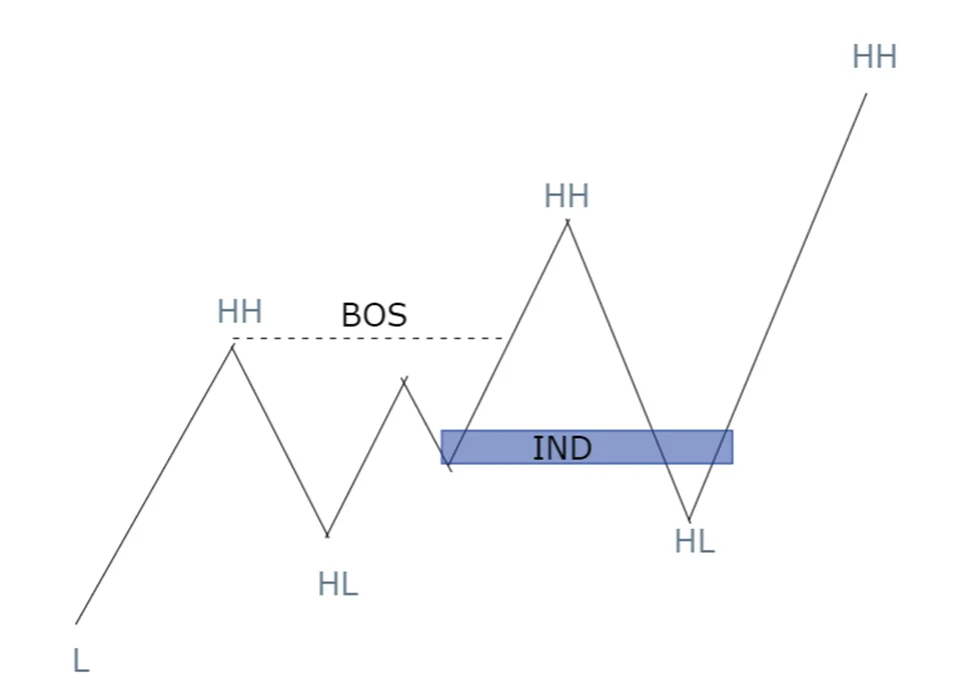
After a BOS, the market often sees a pullback before continuing in the direction of the break. Retail traders might interpret the Order Block in the pullback as an opportunity to enter the market in the direction of the break. However, if this pullback is part of an inducement strategy, smart money might push the price to these levels to trap retail traders before continuing the trend. Identifying inducement here involves recognizing whether the pullback is a valid one or merely a setup to trigger retail entries.
In the case of CHOCH, inducement often occurs with the very first pullback after the market changes its character. This is because the initial retracement following a CHOCH can be a trap designed to lure retail traders into thinking the old trend will continue, while in reality, the market is preparing to move in the opposite direction.
To identify inducement here, traders should look back at the price leg leading to the CHOCH and find a valid pullback. This pullback can serve as an inducement zone where retail traders are trapped before the new trend solidifies.
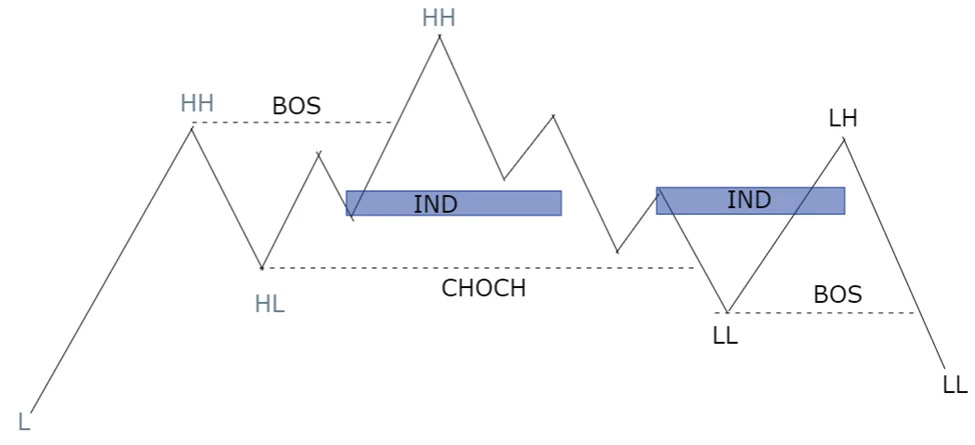
Identification of Inducement in market analysis can be used in our favor. We wait for the price to grab the inducement level. After successfully grabbing the liquidity, we will place our entries accordingly. By understanding and identifying key concepts, a trader can better recognize when they are being induced and avoid falling into these traps.
Inducement in a Bullish Market
In a bullish scenario, the market is creating higher highs. The goal of SMC and ICT trader is to accumulate buy-side orders. In bullish market, price often breaks recent and minor swing lows to capture liquidity and continue its prior direction instead of changing trend.
During an uptrend, traders normally place their stop-loss orders below the recent swing lows. Institutions drive the price lower and performs two actions. The first one is to capture liquidity, and the second one is inducing traders in short selling.
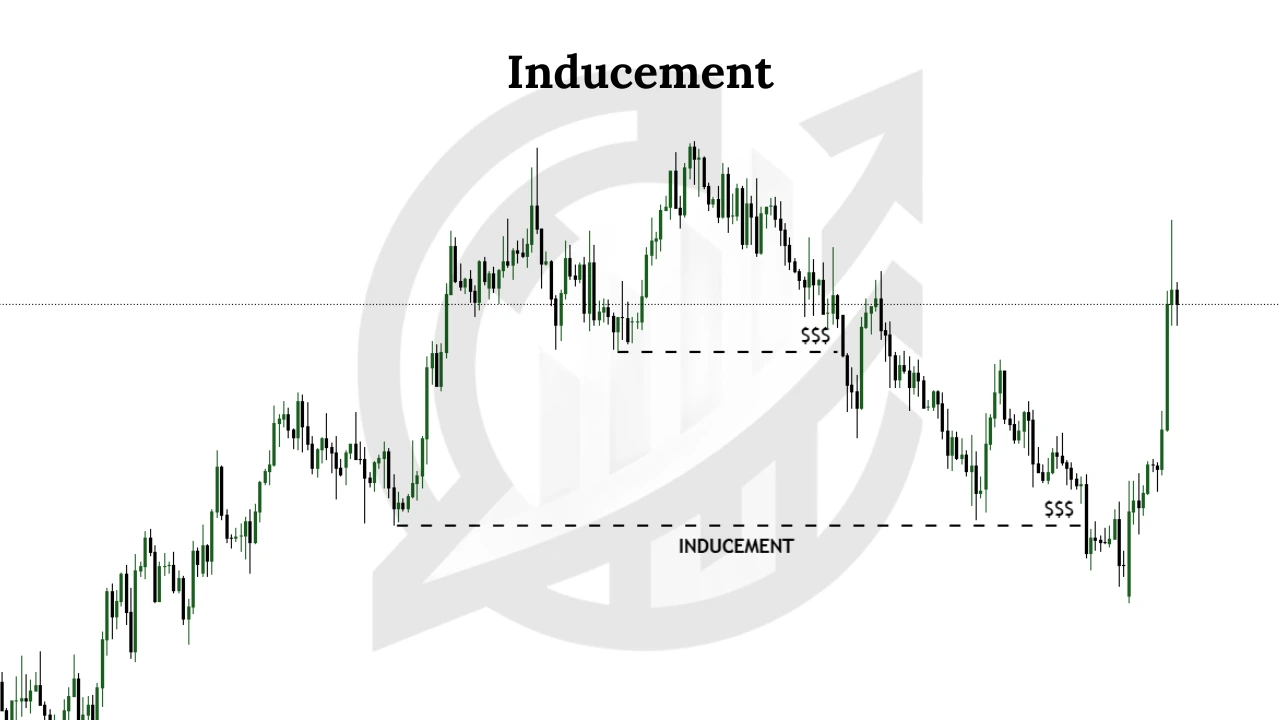
Inducement often appears as a false breakdown of a support level. This breakdown convinces inexperienced traders that the bullish trend is weakening.
Inducement in a Bearish Market
In a bearish scenario, the market is creating lower lows. The goal of SMC and ICT trader is to accumulate sell-side orders. In bearish market, price often breaks recent and minor swing highs to capture liquidity and continue its prior direction instead of changing trend.
During a downtrend, traders normally place their stop-loss orders above the recent swing highs. Institutions drive the price higher and performs two actions. The first one is to capture liquidity, and the second one is inducing traders in buying.
Inducement often appears as a false breakdown of a resistance level. This breakout convinces inexperienced traders that the bearish trend is weakening.
IDM Trading Strategy
Understanding inducement is only useful if you can apply it. Here is a simplified IDM trading strategy framework for beginners:
- Confirm the higher timeframe bias so you know the overall direction you’re working with.
- Identify the most recent BOS or CHOCH, since inducement typically forms in relation to one of these events.
- Mark the first pullback swing as a potential inducement zone rather than an entry.
- Wait for that minor swing to be swept, confirming the inducement has played out.
- Look for price to reach a genuine point of interest (POI), such as an order block or fair value gap, following the sweep.
- Confirm with a lower timeframe structure shift before entering, and place your stop loss beyond the swept extreme rather than at the inducement level itself.
This approach relies heavily on multi-timeframe analysis SMC, since inducement on one timeframe can sometimes be a legitimate point of interest on another. Zooming in and out of your charts is an essential habit for applying this concept correctly.
Never place your entry at the very first pullback following a fresh BOS or CHOCH. Experienced SMC traders treat this zone with suspicion by default, waiting for it to be swept before considering an entry at the next meaningful level.
Example
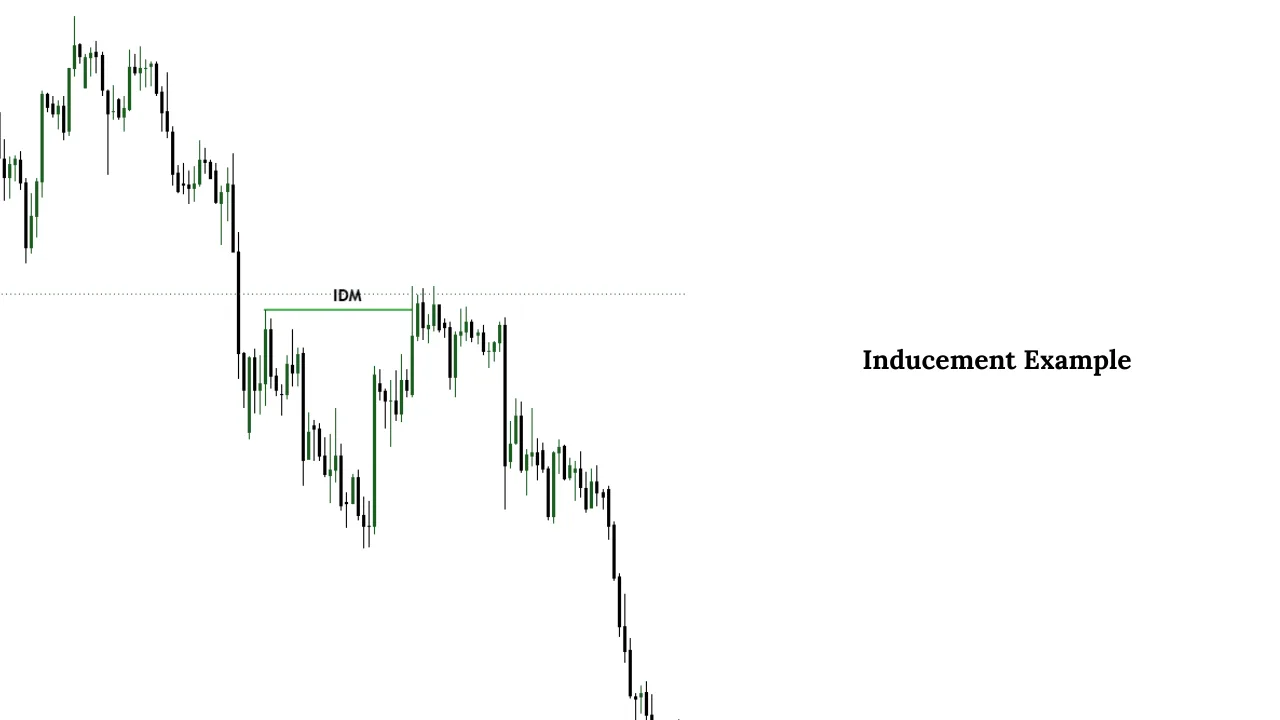
Here is an example of inducement in market that reflects how market continues its prior trend (downtrend) after taking liquidity resting above the recent swing high.
Common Mistakes Beginners Make
- Entering at the first pullback after a BOS or CHOCH. This is very often the inducement itself, not the real opportunity.
- Confusing inducement with a valid entry zone. Not every order block or support/resistance level is genuine — some exist specifically to attract early entries.
- Ignoring the external-to-external inducement pattern, where price consolidates and sweeps liquidity from both sides of a range before making its real move.
- Placing stop losses at the inducement level. Since this level is designed to be swept, a stop placed there is likely to get triggered even if your overall direction is correct.
Using Tools for Faster Analysis
If spotting inducement manually feels difficult at first, that’s completely normal — it’s considered one of the more nuanced SMC concepts to master. Many traders use an inducement indicator TradingView script, or similar IDM indicator MT4/MT5 tools, to help highlight potential inducement zones automatically. These tools can speed up your analysis, but understanding the logic behind inducement will always make you better at judging which signals to trust.
Final Thoughts
Inducement is one of the concepts that separates traders who consistently get caught in false moves from those who patiently wait for the real opportunity. For beginners, the key points to remember are:
- Inducement is a deliberate-looking setup designed to attract traders before the real move happens.
- IDM is simply short for inducement, and the terms are used interchangeably in SMC and ICT trading.
- Inducement typically appears as the first pullback after a BOS or CHOCH, and is followed by a liquidity sweep.
- Not every attractive-looking setup is a genuine opportunity — some are traps by design.
- Confirming with lower timeframe structure and proper stop placement helps protect you from being caught by inducement yourself.
Learning to recognize inducement takes time and screen practice, but once you can consistently separate the trap from the real opportunity, you’ll find your entries becoming far more precise.
Frequently Asked Questions (FAQs)
Does every BOS or CHOCH have inducement?
Not always, but it’s common enough that experienced traders check for it by default. Some structural breaks move directly to their target without a clear pullback trap, while others include multiple layers of inducement before the real move begins.
Is inducement the same in ICT and SMC?
Yes, functionally. Both frameworks describe the exact same market behavior — a retail-trap level that price sweeps before delivering its real direction. ICT traders more commonly say “inducement,” while SMC traders often shorten it to “IDM,” but the underlying concept is identical.
Can inducement fail to get swept?
It’s rare, but possible. If broader market conditions shift unexpectedly, price can sometimes bypass an inducement zone entirely. This is one reason confirmation signals matter more than assuming a pattern will always play out exactly as expected.
How is inducement different from a normal pullback?
A normal, valid pullback respects market structure and offers a genuine opportunity to join the trend. Inducement, by contrast, is specifically the pullback most likely to trap early entries before a sweep and reversal. The two can look identical at first glance, which is exactly what makes inducement so effective as a trap.

I’m Aatiq Shah, a dedicated forex and crypto market practitioner with three years of hands-on experience. Currently, I’m working as a Financial Manager. My journey in the world of finance has equipped me with the skills and knowledge needed to navigate the complexities of the forex and crypto markets.