The most discussed question from ICT traders is “Which setup should I focus on?” It is a reasonable question — the ICT framework is vast, spanning dozens of concepts, entry models, timing rules, and market structure principles that can feel overwhelming when encountered all at once.
However, the question itself contains a hidden problem: most traders who ask it are looking for a shortcut. In ICT trading setups and methods, no such shortcut exists. What does exist is a structured, checklist-driven approach to identifying only the highest-quality setups and refusing to trade anything else.
In the ICT community, these are called A+ setups: trades where every major confluence condition is satisfied simultaneously, where the risk-to-reward ratio is clearly defined and achievable, and where the institutional narrative of the day supports the direction of the trade.

Table of Contents
Core Principle: In ICT trading, the goal is not to trade more — it is to trade better. One A+ setup per day, executed with discipline and proper risk management, produces more consistent results than 10 mediocre setups taken without full confluence. Quality always outperforms quantity in the ICT framework.
Elements of ICT Trading Setups:
It is important to understand market as a whole and elements of a trade setup in smart money trading. In traditional approach to technical analysis, we are dependent on technical indicators and support & resistance. Traditional technical analysis and price action is limited and cannot provide the logic you want. This left traders unaware about market context.
ICT focuses on understanding market structure as whole. ICT trading concepts combine time and price action in trading for better and logical trade entries. ICT trading setups requires an in-depth understanding of ICT trading concepts. As an ICT trader, there two essential elements and concerns:
- Context or Framework surrounding the idea.
- Reference points in institutional order flow.
Context or Framework surrounding the idea.
Trading the market extends beyond simplistic reliance on support and resistance or Candlestick pattern signals; ICT trade setups demands a profound understanding of the broader context. The context refers to the prevailing market conditions, sentiment, and underlying trends that dictate price movements.
A trading signal, no matter how technically sound, holds little value if it contradicts the market’s contextual narrative. To achieve consistent success, traders must align their strategies with the overarching market environment, ensuring that their signals are not isolated but rather a coherent part of the larger market dynamics.
Context, therefore, serves as the critical foundation upon which effective trading decisions are built. In context, ICT focuses on the following market conditions:
- Expansion
- Retracement
- Reversal
- Consolidation
One these four market conditions provide strong framework and context of the market. Market in consolidation phase is preparing for Expansion. From Expansion, there came retracement, and from extremes of expansion market starts to prepare for its reversal.
Our ultimate concern is looking for consolidation phase of the market. It can be accumulation or distribution. From there it decides its expansion phase, but we don’t know whether the market is accumulated or distributed. That is the reason that an ICT trader wait for the first expansion move. The first expansion move decides which side has the control of the market. It is normal that a trader does not catch all moves. We wait for the opportunities.
Expansion
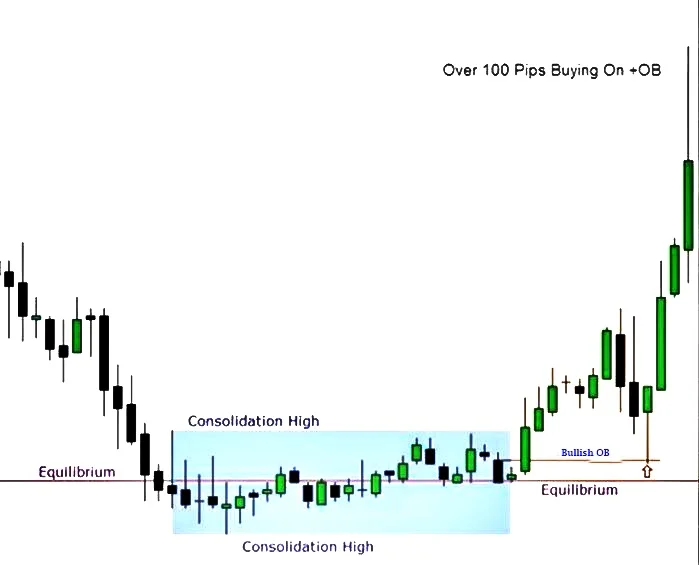
Expansion is when price moves quickly from a level of Equilibrium (consolidation). It’s a direction covered by price and denotes institutional interest. When price leaves a level quickly, leaving an imbalance, it indicates trend strength and willingness on the part of institutions. ICT trader look for the order block which is placed at or near the Consolidation phase.
ICT traders recommend that do not chase the price and wait for the price to reach the order block level.
Retracement
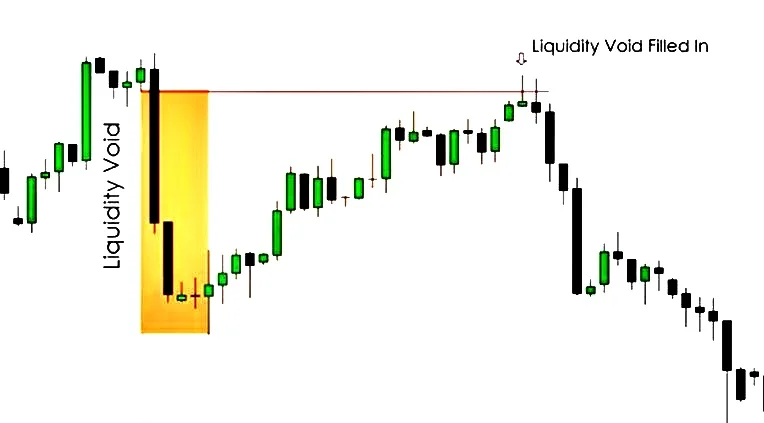
Retracement is normally referred to as pull back inside the recently created price range. It can offer potential entry points. It is important in the case when there are fair value gaps or liquidity voids.
Reversal
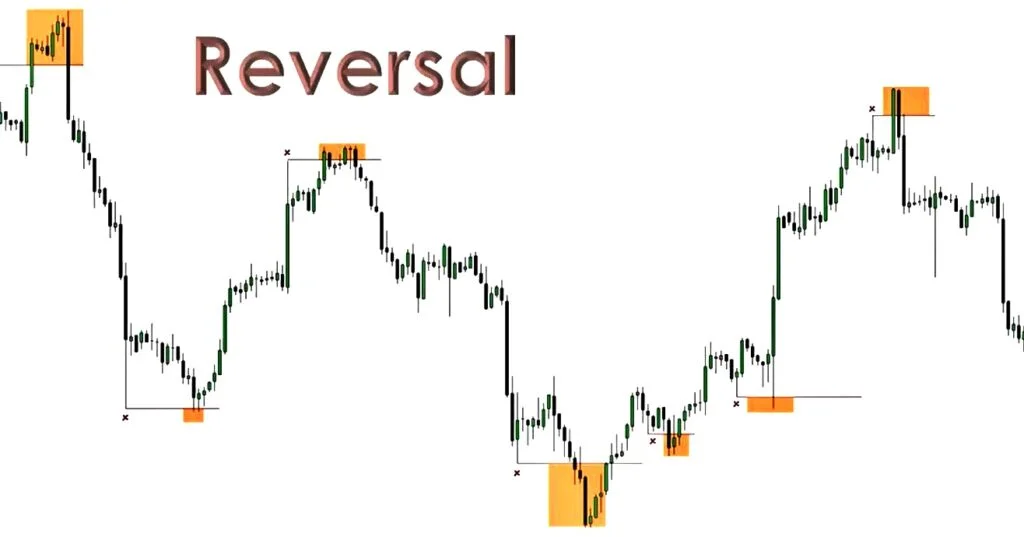
Reversal is the moving of price in opposite direction. Reversal are top and bottom reversals. It changes the current direction of trend into opposite direction. In ICT, reversal indicates that institutions have ran a level of stops and a new move in opposite direction has taken place.
Our important areas to look for is the liquidity pools just above an old price high and just below an old price low.
Consolidation
It is also known as lateralization period of market. During the period, market moves inside a clear trading range and shows no willingness to move significantly higher or lower. Accumulation or distribution by institutions leads to new expansion.
The important for us is to wait for impulse move or swing in price away from the equilibrium price level.
Reference points in Institutional Order Flow
In institutional order flow, reference points are pivotal in constructing a robust ICT trading setups in trading. These points are identified through four key criteria: expansion, retracement, consolidation, and reversal.
Expansion marks the directional thrust where institutional activity drives price, indicating trend strength. Retracement follows as price pulls back, often towards significant levels, offering potential entry points.
Consolidation represents periods of market equilibrium, where price ranges within defined bounds, signaling preparation for a breakout. Reversal occurs when the trend shifts, highlighting a change in institutional sentiment.
By analyzing these elements within the broader market context, traders can pinpoint precise reference points, enhancing trade accuracy and alignment with institutional flows. These reference points can help traders constructing ICT trading setups. The following are the elements we look for in such situations:
- Order block
- Fair value gaps and liquidity voids
- Liquidity pools and stop runs
- Equilibrium
ICT Trading Strategy Foundation
Before exploring specific ICT setups, every trader must understand the four foundational pillars that every single ICT strategy is built on. Without these four elements in place, no specific setup carries meaningful probability.
Directional Bias
For traders, having a clarity in directional bias means knowing your direction before the session opens. ICT trading setups are not reactive, its predictive. Every trading day, before the London session opens, an ICT trader has already determined which direction they will exclusively trade that day.
This is the daily bias: a top-down analysis conclusion that identifies whether the market’s higher-timeframe structure (daily and 4-hour charts) is bullish, bearish, or unclear. If the bias is unclear, the correct response is to not trade at all. Trading without a confirmed daily bias is the most common reason ICT beginners take losing trades.
Draw on Liquidity
Once the daily bias is established, the next question is: where is price going? In ICT theory, price is always being delivered from one liquidity pool to the next.
The Draw on Liquidity (DOL) is the next significant pool of buy-side or sell-side orders that price is being magnetized toward — typically a previous swing high (buy-side liquidity) or a previous swing low (sell-side liquidity). Every setup must have a clear, measurable DOL that is at minimum 2R away from the planned entry.
Kill Zone Timing
ICT Kill Zones are the specific windows during each trading day when institutional price delivery is most reliable and highest-volume. Any ICT setup that forms outside of kill zones is automatically disqualified from A+ status — the probability drops dramatically when institutional participation is thin.
Confluence Stack
Trade setup based on single ICT concept is not an A+ setup. The ICT strategy’s edge comes from confluence: multiple independent signals pointing to the same entry zone at the same time.
The minimum confluence requirement for an A+ trade is three independent confirmations: (1) a liquidity sweep, (2) an MSS on the lower timeframe, and (3) a PD Array (FVG, OB, or OTE zone) at the entry level. More confluences reduce risk and improve the quality of the setup.
Best ICT Trading Setups: The Core Six
The following six setups represent the highest-probability, most widely-traded ICT entry setups. Each has a distinct mechanic, a preferred session window, and an appropriate historical win rate when all conditions are met.
| ICT Setup | Best Session | Win Rate % |
| Silver Bullet Setup | New York | 70-75% |
| Sweep and Reverse | London / New York Killzone | 65-70% |
| Liquidity Raid + FVG | London and New York | 68-72% |
| Breaker Block Entry | Any Kill Zone | 62-68% |
| One Trade Setup for Life | NY PM Session | 65-70% |
| IPDA Range Setup | Weekly/Daily | 70-78% |
ICT A+ Setup Checklist
The is the most important section in this guide. The ICT A+ checklist is what separates profitable ICT traders from unprofitable one. Review the checklist items before every single trade you consider. If any item is missing, skip the trade and move on.
| Checklist Item | What to Verify Before Entering |
| ✅ Daily Bias Confirmed | The dominant trend on the daily/4H chart is clearly bullish (HH+HL) or bearish (LH+LL). You know which direction you are ONLY trading today. |
| ✅ Draw on Liquidity Identified | The next institutional target — a swing high (buy-side liquidity) or swing low (sell-side liquidity) — is clearly visible and at least 2R away from your planned entry. |
| ✅ Trading During a Kill Zone | The setup forms during London Open (2–5 AM EST), New York Open (7–10 AM EST), or the Silver Bullet windows. No setup outside of kill zones. |
| ✅ Liquidity Sweep Completed | Price has swept above a swing high (bearish setup) or below a swing low (bullish setup) — collecting retail stop orders before the real move begins. |
| ✅ Market Structure Shift (MSS) Present | After the sweep, a lower-timeframe (5M or 15M) Market Structure Shift confirms the reversal. A BOS in the direction of your trade has printed. |
| ✅ PD Array Entry Zone Present | An Order Block, Fair Value Gap, Breaker Block, or OTE Fibonacci zone (0.62–0.79) is present at the entry area. You are NOT entering in the middle of a range. |
| ✅ Minimum 1:2 Risk-to-Reward Achievable | Before entering, measure: is TP1 at least 2× the size of your stop-loss? If the R:R is less than 1:2, skip the trade regardless of how good it looks. |
| ✅ No HTF Resistance / Support in the Path | Between your entry and your target, there are no major higher-timeframe blockers — untested daily Order Blocks, weekly FVGs, or opposing liquidity pools. |
| ✅ No High-Impact News Within 30 Minutes | Check the economic calendar. No NFP, FOMC, CPI, or interest rate announcement within 30 minutes of your planned entry. News events override all setups. |
| ✅ Position Size Calculated (Max 1% Risk) | Risk is capped at 1% of total account balance. Position size is calculated before entry — not guessed. Stop-loss automation is active. |
| ✅ Setup Journaled Pre-Entry | Screenshot the pre-trade chart, annotated with: bias direction, DOL, entry zone, stop-loss level, TP1 and TP2 levels, checklist score. Entry only proceeds after journal entry is complete. |
The A+ Standard: A trade scores A+ when all 11 checklist items are confirmed. Anything below 11/11 is a B, C, or F setup — and ICT methodology is clear: only A+ trades get executed. The checklist is not a suggestion. It is the single most powerful risk management tool in the entire framework
Final Note
The ICT trading framework offers a rich, deeply structured set of setups and strategies. But the hard truth is that the specific setup you choose matters far less than the discipline with which you apply it. Every ICT trader who achieves consistent profitability says the same thing: the A+ checklist saved them from themselves.
FAQs
What makes a trade an ICT A+ setup vs a regular setup?
An A+ setup is one where every item on the 11-point checklist is confirmed — daily bias, draw on liquidity, kill zone timing, liquidity sweep, MSS confirmation, PD Array at entry, minimum 1:2 R:R, no HTF blockers, no news risk, calculated position size, and pre-entry journal. A setup missing even one or two of these elements is downgraded to B or C quality.
How many ICT setups should I take per day?
The ICT framework actively discourages high-frequency trading. One to three A+ setups per trading day is the professional standard. Many experienced ICT traders take zero trades on days when no A+ setup forms.
Which ICT setup is best for beginners?
The Silver Bullet setup is universally recommended as the starting point for ICT beginners. It has fixed, defined time windows (10–11 AM and 2–3 PM EST), a clear mechanical entry trigger (FVG retest after Judas Swing), a straightforward stop-loss placement, and produces regular setups on the most liquid pairs and markets.
Does ICT strategy work on prop firm challenges?
Yes. Prop firms evaluate traders on consistency, drawdown control, and profit targets rather than raw win percentage. The A+ checklist enforces the discipline prop firms reward. Documented prop firm success rates with ICT methodology are cited at 65–75% pass rates when the framework is applied correctly.

I’m Abdullah Shah, a content writer with three years of experience in crafting engaging and informative content. My background in market analysis complements my work, allowing me to create content that resonates with audiences. I’m also a seasoned practitioner in the forex and crypto markets, with a strong foundation and deep interest in finance. My passion for the financial world drives me to produce content that is both insightful and valuable for those interested in understanding market trends and financial strategies.